Hormones and embryos: Understanding steroid metabolism in European starling eggs

Featured Scientist: Nicole A. Campbell, M.S. 2019, School of Biological Sciences, Illinois State University 

A picture of Nicole Campbell at the aquarium Touch Pool. She has her hand in the water and there is a stingray beneath her hand. She is looking up and smiling at the camera.

Birthplace: Joliet, IL 

My Research: I am fascinated by the process of embryonic development. As an embryo develops, it is critical that the correct hormones are expressed at the right times to ensure that the embryo is healthy. My work focuses on embryos of the European starling, but my research can also help us to understand human systems. People used to think that hormones directly affect an embryo as it grows and develops, but this idea is at odds with what we know about how these hormones are broken down in the body. As an embryo grows, hormones are quickly processed through metabolism. With the help of my adviser Dr. Paitz, I examined a different idea: that the effects of hormones are driven by their metabolites

Research Goals: I hope to continue research in the future by working with animal breeding programs to help endangered species. 

Career Goals: I want to have a career where I can apply science to help breed and restore endangered animal species. I am hopeful that this work will help me transition to a career where I get to work directly with endangered species, like the red panda. 

Hobbies: I love crafting cute projects that I find on Pinterest and managing my dog’s Instagram page. 

Favorite Thing About Science: My favorite thing about science is being able to visually see things, like embryos, while they are developing. I get to see natural processes in person. It’s pretty amazing how something so small can contain all of the information about how an animal develops.

Organism of Study: European starling 

A picture of a bird on a tree branch.
Adult European starling 
A picture of an egg being “candled”. The scientist shines a light under the egg to see where the embryo is. The embryo is a small red dot on the top left corner of the yolk.
European starling egg/ embryo 

Field of Study: Comparative Endocrinology

What is Comparative Endocrinology? Comparative Endocrinology is the study of hormones and their effects on various aspects of development in animals. My research uses animal models to test the effects of different hormones, which can inform us about their roles in the human body. 

Check Out My Original Paper: “Characterizing the timing of yolk testosterone metabolism and the effects of etiocholanolone on development in avian eggs” 

QR code to the original publication

Citation: N.A. Campbell, R.A. Angles, R.M. Bowden, J.M Casto, R.T. Paitz, Characterizing the timing of yolk testosterone metabolism and the effects of etiocholanolone on development in avian eggs. J. Exp. Biol. 223.4: (2020)

Research at a Glance: When birds lay eggs, the yolk contains both hormones and nutrients for the developing embryo. In this paper, I investigated how starlings break down hormones in the egg. I also studied important metabolites of this breakdown and conducted tests to see if the metabolites affected embryonic growth. 

It’s important to know how long specific hormones remain in an embryo. If we know how long a hormone is present, then we can determine whether or not it will influence the embryo. In this study, we looked at the hormone testosterone, to see how quickly it breaks down during early development in starling embryos. Surprisingly, we found that most of the testosterone is broken down within just a few hours. This result raised another question: how does testosterone affect the embryo if it is broken down so rapidly? 

We guessed that testosterone may affect the embryo’s secondary metabolites. Secondary metabolites are the products that are made when hormones are broken down. Our work showed that these metabolites stick around inside the egg yolk much longer than testosterone. We set out to see if these metabolites affect the growth of the embryo. We injected extra amounts of a secondary metabolite, etiocholanolone, into the eggs. Our results did not show that extra etiocholanolone affected embryonic development. One explanation for our results is that there was already etiocholanolone present in the eggs. 

Highlights: I think the most important step for my research is the study that we did on in ovo testosterone metabolism. We performed this experiment over the course of two laying seasons. In the first season, we gathered 38 freshly laid starling eggs from our study site and took eggs from 36 different clutches. We purchased a radiolabeled form of testosterone that would allow us to keep track of testosterone levels as the embryos grew. We injected each egg with testosterone mixed with sesame oil. The oil was used to keep the injection of the radiolabeled testosterone in one spot near the embryo. We did this so that the testosterone could diffuse from that central area into the embryo. Then, each egg was allowed to grow for different lengths of time in an incubator. The period of time that the eggs were allowed to grow was assigned randomly. 

Next, we wanted to see what happened to the testosterone. We removed the eggs from the incubator, froze them, and separated the egg into two parts: the yolk and albumen. We weighed each part, then separated out the hormones. We were able to isolate the hormones using two techniques: solid phase extraction and column chromatography. Finally, we put the samples through a scintillation counter. The scintillation counter helped us test which metabolites had our radiolabel on them. By figuring out which metabolites had our radiolabel, we could tell how much of the testosterone we injected had broken down. 

When we repeated this experiment in the second season, we used more testosterone for our injections and shortened the length of time that eggs were allowed to grow. 

We sampled embryos within a 12-hour window. We also mixed the yolk with the albumen when we sampled and used a yolk/albumen mix to extract hormones. Our results show that after incubation starts, the testosterone in the egg breaks down quickly. This means that testosterone probably does not directly affect how the embryos develop. Instead, we think that the testosterone metabolites are responsible. 

What My Science Looks Like: Figures 1-3 show the results of my experiment from the second season, where we added testosterone to the eggs and tracked how testosterone was broken down over the course of 12 hours. Each figure shows the average radioactivity on the y-axis. This tells us how much of the testosterone or metabolite is found in the yolk/ albumen mixture. 

We looked at testosterone and two of its metabolites, androstenedione and etiocholanolone. In Figure 1, we see that the amount of testosterone in the eggs is rapidly dropping over time. 
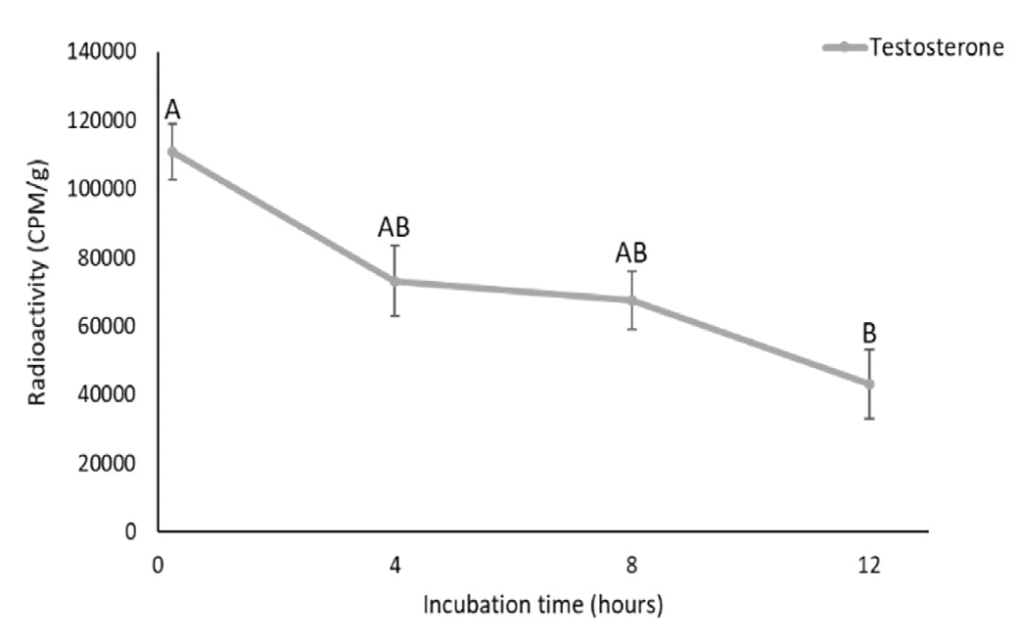
A data figure that shows the amount of radiolabeled testosterone over time. The x-axis shows Incubation Time (hours). The y-axis shows Radioactivity (CPM/g). The figure shows that testosterone is significantly higher at zero hours (it falls between 100,000 and 120,000 CPM/g) than at 12 hours (it falls between 40,000 and 60,000 CPM/g).
Figure 1. The amount of testosterone in the embryo 
after 12 hours of incubation. Figure adapted from Campbell et al. 2020. 

In Figure 2 and Figure 3, both androstenedione and etiocholanolone start to increase after only 4 hours of incubation. The fact that they both show up so early indicates that testosterone is being broken down quickly once the egg is incubated. 

A data figure that shows the amount of radiolabeled androstenedione over time. Axes are the same as in Figure 1. The figure shows that radiolabeled androstenedione is low at zero hours (just over zero CPM/g) and significantly increases after four hours of incubation (20,000 CPM/g). The amount of androstenedione stays relatively constant after 4 hours of incubation.

Figure 2. The amount of androstenedione, a testosterone metabolite, in the embryo after 12 hours of incubation. Figure adapted from Campbell et al. 2020. 
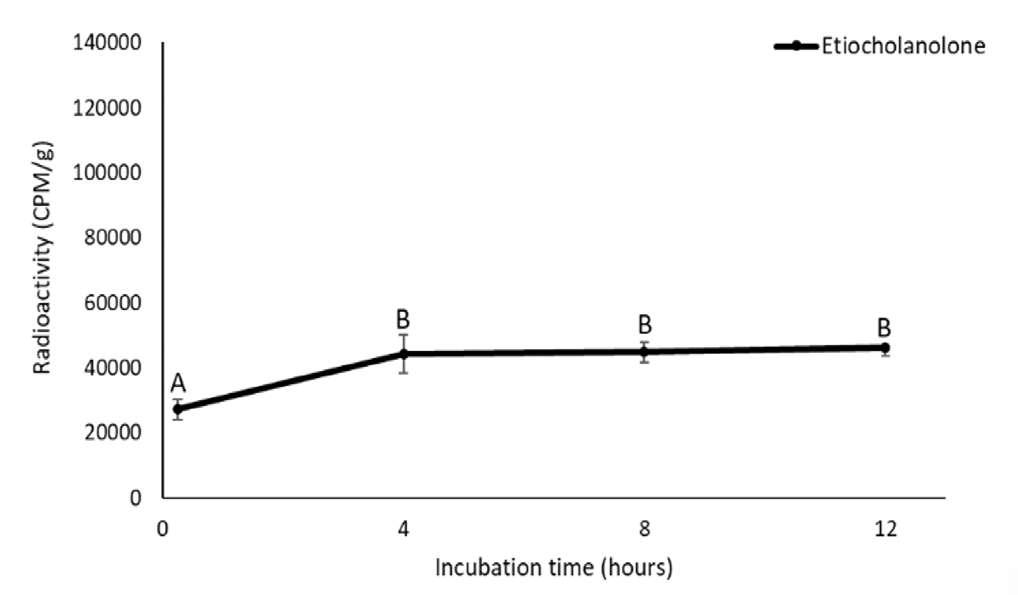
A data figure that shows the amount of radiolabeled etiocholanolone over time. Axes are the same as in Figure 1. The figure shows that radiolabeled etiocholanolone is low at zero hours (25,000 CPM/g) and significantly increases after four hours of incubation (45,000 CPM/g). Similar to the other metabolite, the amount of etiocholanolone stays relatively constant after 4 hours of incubation.

Figure 3. The amount of etiocholanolone, a testosterone metabolite, in the embryo after 12 hours of incubation. Figure adapted from Campbell et al. 2020. 

The Big Picture: We show that testosterone metabolites are present near the embryo before many key processes begin. We put forth the idea that testosterone itself may not be a major driver of developmental effects. Instead, testosterone metabolites may cause these effects. This type of research is important because it can tell us what may happen if normal hormone levels in early development are disturbed. 

Decoding the Language: 

Albumen: The white part of the egg that is water-soluble and that contains proteins.

Androstenedione: A hormone and metabolite of testosterone.

Clutch: A group of eggs that are laid at one time.

Column chromatography: A method used to isolate a single chemical compound from a mixture of compounds. Each compound moves through the column at different rates and this allows them to be separated. 

Diffuse: To permit or cause to spread freely. In the context of this study, we wanted testosterone that was placed inside the egg to diffuse into a growing embryo.

Embryo: An unborn or unhatched offspring that is actively growing. In the context of this research, the embryo is the developing starling inside the egg. 

Embryonic development: The process that takes place as an embryo grows and develops into an organism.

Etiocholanolone: A metabolite of testosterone.

Hormones: The signaling molecules that regulate the body and keep it in balance. These are produced by different glands within the body and are transported by the blood to target organs. 

Incubation: The process of keeping an egg warm enough to develop until hatching.

Metabolites: The products of metabolism, or breakdown.

Radiolabel: A way to tag a substance or compound with a radioactive tag. 

Scintillation counter: A machine that detects and measures the amount of radioactivity in a sample. It uses light pulses created by excited electrons or ions. 

Solid phase extraction: A technique where compounds are suspended in a liquid mixture and are separated from other compounds in the mixture based on their physical and chemical properties. 

Testosterone: A hormone that is important in the development of male secondary sex characteristics, but is also important in other body processes of both males and females. 

Yolk: The yellow-orange, nutrient-rich portion of the egg that supplies food to the developing embryo. 

Learn More: Below are some research papers for further reading. 

C. Carere, J. Balthazart, Sexual versus individual differentiation: the controversial role of avian maternal hormones. Trends Endo. Metab., 18.2: 73–80 (2007). 

N. Kumar, A. van Dam, H. Permentier, M. van Faassen, I. Kema, M. Gahr, T. G.G. Groothuis, Avian yolk androgens are metabolized instead of taken up by the embryo during the first days of incubation. J. Exper. Biol. 222.7 (2019). 

R.T. Paitz, R.M.Bowden, J.M. Casto, Embryonic modulation of maternal Steroids in European starlings (Sturnus vulgaris). Proc. R. Soc. B Biol. Sci. 278.1702: 99–106 (2011). 

Synopsis edited by: Kate Evans, PhD (Anticipated Spring 2025) and Rosario Marroquin- Flores, PhD (Anticipated Spring 2022), School of Biological Sciences, Illinois State University. 

Download this article here

Please take a survey to share your thoughts about the article!
Who were the people of Spracklen? Studying Native American community through their tools

Illinois State University contributor

Featured Scientist: Tyler R. E. Heneghan, M.S. 2018, Department of Sociology and Anthropology, Illinois State University

A picture of Tyler Heneghan is in front of a table, setting stone piece onto trays.
Tyler fills the Midwest Archaeological Lab with the Spracklen collection, sorting and separating the lithics by material type. 

Birthplace: Shelbyville, IN 

My Research: I study tools made of stone to understand prehistoric Native American communities. The tools I study come from a place called Spracklen, an archaeological site located in Ohio. 

Research Goals: I use a technique called use-wear analysis to better understand what the Ohio Hopewell peoples did in the uplands, and show archaeologists that more information can be gleaned from current collections, without the need to excavate more. 

Career Goals: I am currently a student at Boston University School of Law studying international cultural heritage law. Cultural heritage law involves protecting, regulating, and repatriating cultural items, including the return of historic real property, ancient and historic materials, artwork, and intangible cultural heritage. The Native American Graves Protection and Repatriation Act is one federal legislation regulating museums’ and federal agencies’ collections. 

I hope to aid in the return of cultural heritage around the world and bring it back to the people and communities to whom it belongs. This summer, I will intern with the environmental nonprofit law firm, Earthjustice: Tribal Partnerships. This law firm provides legal aid to Tribes, such as the Standing Rock Sioux, in their fight against the Dakota Access Pipeline. Upon graduation, I hope to use my legal degree, coupled with my M.S. in Anthropology from ISU, to continue in this field and better protect the past for the stakeholders of today and tomorrow. 

Hobbies: Flintknapping (creating stone tools), vexillology (study of flags), scuba diving, and board games. 

Favorite Thing About Science: I love the fluidity of science and how we will never run out of things to learn and improve upon. 

Organism of Study: Stone tools 

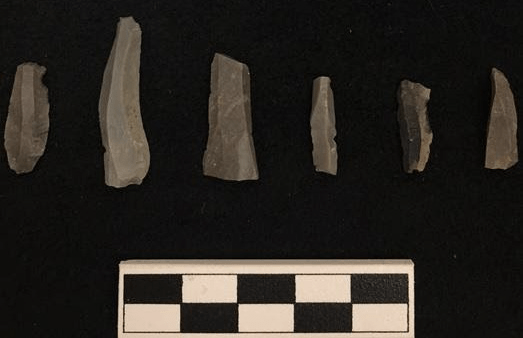
A series of 6 small stones, carved into different shapes.
Sample of bladelets recovered from Spracklen. 

Field of Study: Prehistoric Archaeology 

What is Prehistoric Archaeology? Prehistoric archaeology is the study of human culture through the analysis of the things that people leave behind. These may be structural items, plant, animal, lithic, or ceramic remains. 

A magnified image of different stones, focusing on the grooves and points of the tools.
These are examples of use-wear traces from the stone remnants found at Spracklen. We look at the grooves of the stone to figure out what it was used for. Evidence of scraping can be found at the edge of the stone. Repeated scraping leads to striations that are perpendicular to the blade edge, but cutting leaves more generic striations. Evidence of use for softer materials (i.e. hide and meat) can be found further back on the stone. Evidence of harder contact materials can be found on the edge of the stone. A) Meat cutting (magnified 50x) ; B) Bone cutting/incising (magnified 200x) ; C) Dry hide scraping (magnified 200x) ; D) Dry hide cutting (magnified 200x) ; E) Fresh hide scraping (magnified 200x) ; F) General/Unknown (magnified 50x) 

Check Out My Original Paper: “Spracklen (33GR1585): New Insights into Short-Term Middle Woodland Sites in the Uplands”

QR Code for original publication

Citation: G.L. Miller, T.R. Heneghan, Spracklen (33GR1585): New Insights into Short-Term Middle Woodland Sites in the Uplands, J. Ohio Archaeology. 5: 1-15 (2018). 

Research At A Glance: This paper is a summary of my recent fieldwork and analysis at Spracklen (33GR1585), a small upland site in Greene County, Southwest Ohio. Most of my analysis of prehistoric Ohio focuses on large Hopewell earthworks. Earthworks are man-made or otherwise artificial soil deposits that result from the humans that inhabit the area. Examples of these such earthworks are the Fort Ancient Earthworks, Mound City, and Seip Earthworks. The regions that surround these earthworks are called uplands and they remain understudied. Because of this, the whole picture of Hopewell peoples is incomplete. 

At my field site, Spraklen, we found artifacts and structural features that showed us that the site was occupied for short periods of time, mainly during the Middle Woodland Hopewell period (100 BCE to 500 CE). During this time, the Hopewell peoples used stones to create tools. Bladeletes are the sharpened tools they used for cutting. Bladelet cores are the stones that were used to create these tools. As the bladelets are carved from their cores, small pieces remain. These are referred to as chert debitage. Spracklen contains dozens of bladelets, bladelet cores, and non-local chert debitage, consistent with other Middle Woodland Hopewell sites. 

Highlights: The major portion of my master’s thesis focuses on the use-wear of the completed stone tools at Spracklen. However, my publication focuses on the stone remnants, or by-products, that were found at my archaeology site. This is called lithic debitage. My job was to find the source for all of the lithic debitage I gathered at the site by comparing it to remnants from other known locations. Upwards of seventy percent of the 3,679 lithic debitage pieces I found were from Indiana Hornstone (a.k.a. Harrison County). Indiana Hornstone and Spracklen are not neighboring sites, so these tools must have been carried from one site to the other. I am continuously fascinated by how tools can reconnect prehistoric trade networks and voyages.

Another contribution I made to the article involved identifying lithic debitage, or “flake,” size and shape. Previous research had identified signs of initial tool making. However, my advisor Dr. Miller and I found what we believe are by-products of tool resharpening. At the Spracklen site, we found thin flakes that were short and/or narrow in size. We compared the median thickness to the median relative thickness of these flakes to classify them into one of four categories: unitensive core reduction, intensive core reduction, tool resharpening, and tool manufacture (Figure 1). Unintensive and intensive bladelet core reduction is the process of shaping chert into small pieces. Once those pieces are small enough for transportation, they are turned into finished tools by the tool manufacturing process. 

A data figure that shows the relative size of stone flakes and their location of origin. A group of flakes are of similar size and are classified as being used for Tool Resharpening. Flakes of this size come from Flint Ridge, Upper Mercer, Harrison County, and Unknown locations. Essentially, this figure shows that flakes found in Spraklen were largely used for Tool Resharpening and are from multiple different areas.
Figure 1. Debitage shape analysis from Spracklen. For each individual flake, I recorded median thickness and a relative median thickness. I plotted these two values against each other. The size of each individual flake is denoted by an X on the chart. Flakes of different sizes were grouped together based on their predicted use (colored ovals) and the color of the X signifies the original location of the flake. As you can see, the majority of the X’s fall in the tool resharpening region, supporting the idea that Spracklen was a short-term settlement. This chart shows that tool resharpening was the primary process of stone reduction at Spracklen. 

The flakes found at Spracklen indicate that the tools were mostly resharpened at this site. Spracklen was a short-term campsite and tools had to be durable for a successful trip to the uplands. Thus, tool resharpening allowed the Spracklen people to spend more time at the site before locating materials to make more tools. Since we found non-local stone remnants, or cherts, we can say that the general tool strategy for the Hopewell peoples was tool resharpening. This also supports that Spracklen was a short term site. 

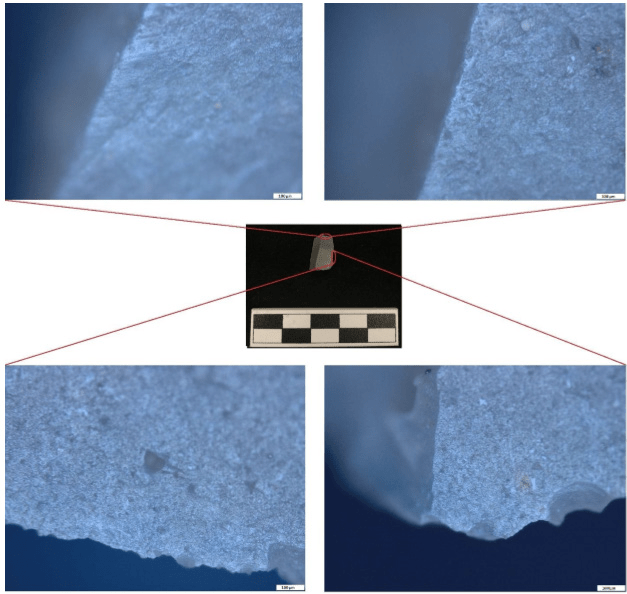
What My Science Looks Like: To the right are magnified images of use-wear analysis traces. 

A picture of a single stone tool. Four edges around the stone are magnified to look at the patterns on its edges.
Use-wear traces indicating lithic use. The top two images show fresh hide scraping use-wear (100x). We can tell because of the perpendicular striations from the snapped bottom edge. The bottom two images show meat butchering use-wear traces (100x) we can tell by the polish developing further back from the blade edge. This polish pattern would develop as bladelets penetrate the meat. 

The Big Picture: Many archaeological sites consist of lithic and/or ceramic remnants. Without structural remains, these tools and ceramics are the best way to understand past life. I predominantly study the polish and striations on stone tools. I study this using a microscopic analysis called use-wear analysis. Use-wear analysis provides key insights into past life and allows for a better understanding of what people were doing at a point in time. Additionally, it is neither intrusive nor destructive to the tool. 

Decoding the Language: 

Bladelets: A stone tool used for many purposes and synonymous with the Ohio Hopewell peoples (think a prehistoric Swiss Army knife).

Bladelet cores: A stone used to create bladelets. 

Debitage/flakes: The by-products of stone tool production. 

Earthworks: Large man-made deposits of soil that indicate the presence of prehistoric human inhabitants.

Lithics: Stone remnants found at an archaeology site.

Non-Local Chert: Chert is a fine-grained sedimentary rock. This was a universally preferred material for making stone tools. In the context of this paper, non-local chert is chert that was transported to the site via trade or travel (i.e. chert originating from Indiana found in Southern Ohio). 

Striations: Lines that indicate the direction that the tool was used. These are created by repeated motions from using the tool, such as cutting or scraping. This use creates diagnostic lines. For example, lines going perpendicular to the edge of the tool towards the center indicates scraping.

Use-wear analysis: The process of looking at stone tools under a microscope to analyze the polish and striations to understand how the tools were used. 

Learn More: 

An article that described use-wear analysis

An article on Hopewell culture from the Ohio History Connection

A link to Tyler Heneghan’s Master’s thesis

Synopsis edited by: Aleksandra Majewski, M.S. (Anticipated Summer 2020) and Rosario Marroquin-Flores, PhD (Anticipated Spring 2022) School of Biological Sciences, Illinois State University

Download this article here

Please take a survey to share your thoughts about the article!

Muscular activity makes Duchenne muscular dystrophy worse in a worm model

Featured Scientist: Kiley Hughes, PhD candidate (Anticipated Spring 2022), School of Biological Sciences, Illinois State University

A picture of Kiley Hughes in a research laboratory. She is looking into microscope.

Birthplace: Seattle, WA 

My Research: I study how Duchenne muscular dystrophy progresses. My research is focused on figuring out how the absence of the dystrophin protein causes the disease. 

Research Goals: I want to continue using behavioral and molecular techniques to research neuromuscular disorders

Career Goals: I want to be a scientist! I would love to work on a larger research team for a research institute that shares their work with the public. 

Hobbies: I like to cook and paint, go outside when the weather allows it, and play with my two cats. 

Favorite Thing About Science: My favorite thing about science is the unknown, there is always more to know and understand. I allow my curiosity to drive me. 

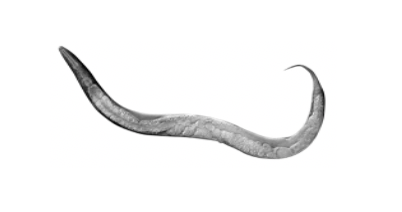
Organism of Study: I study a species of microscopic worm, Caenorhabditis elegansC. elegans is a model organism, which means that scientists have been using it for research for many years and we know a lot about it. This species of worm is often used to study human diseases. 

An image of Kiley’s model organism, C. elegans. It shows the image of a worm, where the internal organs are visible.
The picture above is the nematode worm, C. elegans. They are about 1mm long, transparent, and feed on microbes

Field of Study: Molecular Neuroethology 

What is Molecular Neuroethology? In this field, we use molecular techniques to understand the way organisms interact with the environment and specifically look at the cause of different types of behavior. 

Check Out My Original Paper: “Physical exertion exacerbates decline in the musculature of an animal model of Duchenne muscular dystrophy” 

QR Code to the original publication

Citation: K.J. Hughes, A. Rodriguez, K.M. Flatt, S. Ray, A. Schuler, B. Rodemoyer, V. Veerappan, K. Cuciarone, A. Kullman, C. Lim, N. Gutta, Physical exertion exacerbates decline in the musculature of an animal model of Duchenne muscular dystrophy. PNAS. 116.9: 3508-3517 (2019). 

Research at a Glance: Duchenne muscular dystrophy is a degenerative disease that affects 1 in 3500 males and there is still a lot that we do not know about this disease. My research looks at how the loss of the muscle protein, dystrophin, leads to muscle death. I study the extent to which exercise might be able to protect dystrophic muscles. In this study, we used the nematode worm, C. elegans, and our worms have Duchenne muscular dystrophy. We used them to show that calcium was not being properly regulated in their bodies, even before the worms show symptoms of the disease. We also observed that some types of muscle activity increased muscle repair. However, no treatment positively affected the life expectancy of dystrophic animals. 

Highlights: For a muscle to contract, the body needs both energy and calcium. We used a special worm that has a green protein that will glow when it is in the presence of calcium. Worms move in a wave-like fashion. Because of this, each contracting muscle should have an opposite relaxed muscle. We used our special worm to do in vivo calcium measurements (Figure 1). 

A figure that shows the image of a worm, with its body in a wave-like shape. Actively contracting muscles are bright green, opposite to the contracting muscle is a relaxing muscle, which is a darker color. The brightness ratio is the difference between these two colors.
Figure 1. Image of the C. elegans dystrophic worm. The contracting muscle is bright and the relaxed muscle is dark. We used imaging software to measure the ratio of bright to dark muscles. 

We found that in dystrophic worms, not only was muscle calcium higher, but this persisted in both contracting and relaxing muscles. 

What My Science Looks Like: We can use electron micrographs to see what happens to the muscles in worms that have Duchenne muscular dystrophy. We make them by taking a worm and freezing it under very high pressure. The frozen worms are treated with heavy metals, then cut into really small slices (like pastrami). The slices shown in Figure 2 are from the midbody of a worm and they show the worm’s muscle structure.

A figure that shows two images. The image on the left shows the musculature of a wild type worm. The tissues are organized such that the mitochondria, basal lamina, sacromeres, A band, M line and muscle belly can be seen (each are denoted with a small black line). The image on the right shows the musculature of a worm with muscular dystrophy. There is not clear organization of the tissue and no parts are labeled.
Figure 2. Magnified image of C. elegans muscle tissue in a wild type worm (left) and a dystrophic worm (right). Adapted from Hughes et al. 2019. 

The image on the left is from a wild type worm, which means that this worm does not have the disease. The left image shows what a normal, healthy, muscle should look like. The image on the right shows the muscle structure of a dystrophic worm. The muscle in the dystrophic worm is degenerating. 

The Big Picture: Thousands of people are living with Duchenne muscular dystrophy in the United States. These patients are wheelchair bound by the age of 12 and die prematurely from heart failure in their 30’s. Research has been slow in this field because most of the animals that have the human version of Duchenne muscular dystrophy do not show the same type of degeneration. However, when our dystrophic worms burrow, they show muscle decline similar to humans. Using this model, we hope to understand how people with this disease are getting so sick. 

Decoding the Language: 

Caenorhabditis elegans (C. elegans): The worms that we use to study Duchenne muscular dystrophy. This might seem strange, but they’re a great model organism to understand the disease. What we find can be translated to humans! 

Degenerative disease: Diseases that are caused by the abnormal break down of cells over time. 

Duchenne Muscular Dystrophy: A fatal neuromuscular disorder that causes weakness in and loss of skeletal and heart muscle. This disease is caused by abnormal dystrophin proteins. 

Dystrophic: A term used to refer to animals that have absent or abnormal dystrophin proteins. 

Dystrophin: The muscle gene/protein that is absent in patients with Duchenne muscular dystrophy. 

Electron micrograph: A form of imaging that can be done using a specialized microscope.

In vivo: Measurements or experimental procedures that take place inside of a living organism. 

Microbes: A microscopic organism, like bacteria.

Model organism: A species that has been very widely studied. These species are often easy to breed and to take care of in the lab. Because they have been studied for so long, scientists have developed a lot of genetic resources that can be used to model human diseases using these animals. 

Neuromuscular disorders: These are diseases that affect muscles and how the nervous system controls those muscles. Molecular techniques: A method used to manipulate and understand DNA, RNA, or protein. 

Wild type: An animal that has not been manipulated. It should have the same genetic and physical characteristics as if it were found in the wild. 

Learn More: 

Why use the worm?

Synopsis edited by: Eric Walsh, M.S. 2020, and Rosario Marroquin- Flores, PhD (Anticipated Spring 2022), School of Biological Sciences, Illinois State University.

Download this article here

Please take a survey to share your thoughts about the article!

One way to better predict sex ratios in species with temperature-dependent sex determination

Featured Scientist: Amanda Wilson Carter, PhD 2017, National Science Foundation Postdoctoral Research Fellow at the University of Tennessee (former PhD Candidate at Illinois State University, School of Biological Sciences) 

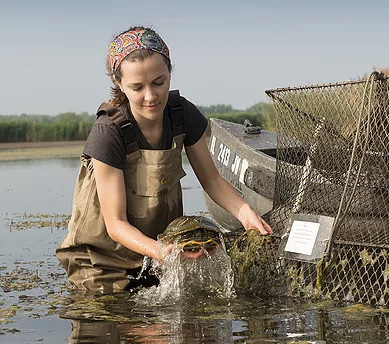
A picture of Amanda Wilson Carter at her field site. She is in a marsh wearing waders. She is next to a canoe, holding a turtle that was just removed from a trap.

Birthplace: New York City, NY 

My Research: I study how animals are affected by changes in their environment. 

Research Goals: I want to understand how changes in temperature affect animal physiology. I would like to be able to better predict how climate change will affect all types of animals. 

Career Goals: I am currently working towards increasing the participation of underrepresented groups in science. My goal is to become a biology professor and researcher. 

Hobbies: Traveling, playing with my dogs, and renovating my 1940’s bungalow. 

Favorite Thing About Science: I love having the freedom to explore questions that I think are necessary and important. Throughout my schooling and career, I have also discovered a passion for mentoring students through independent projects in the lab. There is something very special about watching an undergraduate conduct their first study and transform into a confident and capable young investigator. 

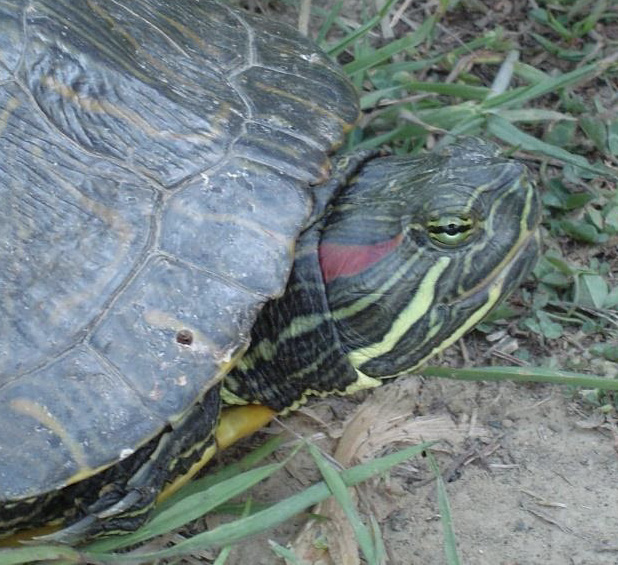
Organism of Study: I study many animals, but my PhD research focused on turtles, mainly the red-eared slider (Trachemys scripta). In my current position, I conduct research on dung beetles. 

A picture of a red-eared slider turtle on the ground. The turtle has a red band on the side of its head.
Red-eared slider turtle (T. scripta). Image source 

Field of Study: Eco-physiology | Climate Change | Plasticity | Development | Parental Effects 

What is Eco-physiology? I broadly consider myself an eco-physiologist. I study how the physiology and behavior of animals are affected by their environment (mainly temperature).

Check Out My Original Paper: “The Devil is in the Details: Identifying Aspects of Temperature Variation that Underlie Sex Determination in Species with TSD” 

QR Code to original publication

Citation: A. W. Carter, R.T. Paitz,R. M Bowden, The Devil is in the Details: Identifying Aspects of Temperature Variation that Underlie Sex Determination in Species with TSD. Int Comp Biol. 59.4: 1081-1088 (2019). 

Synopsis written by: Josselyn Gonzalez, M.S. (Anticipated Spring 2021), School of Biological Sciences, Illinois State University

Research at a Glance: The goal of this research was to help understand how animals respond to changes in temperature. To do this, Amanda used the red-eared slider turtle to study temperature-dependent sex determination (TSD). TSD is when the sex of an animal is affected by incubation temperatures. For example: red-eared slider turtles are typically male unless they experience warmer temperatures during development. If eggs are in warmer temperatures, even if it’s just a few days, then it will cause the turtles to develop as female instead of male.

It is important to be able to predict sex ratios, or the amount of male and female turtles, in nature. We want to know how future changes in temperature may affect animals, especially for those that are sensitive to temperature. Constant Temperature Equivalents (CTEs) are used to guess the number of female turtles produced when eggs are exposed to temperatures that go up and down, similar to how temperatures go up during the day and down during the night. They are very common in this type of research and have been used to predict sex ratios for many years. Recent research suggests that CTEs may not be the most accurate way to predict sex ratios in the wild. 

Amanda’s goal was to determine if using the number of days at higher temperatures (female-producing temperatures) is a better way to predict the sex ratios than using CTEs. To test her question, Amanda used two groups of red-eared slider turtles (one from Illinois and one from Louisiana). She also looked to see if the turtles from Illinois and Louisiana responded similarly to temperature changes.

Amanda found that the best way to predict turtle sex ratios is to count the number of days that eggs are at higher temperatures. Using the CTE that eggs experience throughout incubation was not as accurate. She also found that turtles from Louisiana were more sensitive to temperature changes than turtles from Illinois. 

Highlights: Amanda collected 183 turtle eggs and put them into different temperatures as they developed. Amanda chose temperatures that go up and down, similar to how temperatures go up during the day and down during the night. All of the eggs started at male-producing temperatures (25 ± 3°C) for 25 days. She used 22°C (71.6°F) for her nighttime temperature and 28°C (82.4°F) for her daytime temperature. Then, she switched all of her eggs to female-producing temperatures (29.5 ± 3°C). She used 26.5°C (79.7°F) for her nighttime temperature and 32.5°C (90.5°F) for her daytime temperature. The eggs stayed at female-producing temperatures for 8, 11, 14, 17, 20, 23, 26, 29, 32, or 35 days. Finally, all eggs were returned to male-producing temperatures (25 ± 3°C) until they hatched. Once turtles were 6 weeks old, Amanda determined the sex of each hatchling. The sex of each hatchling from this experiment was combined with the previous year’s data to help determine the best way to predict sex ratios

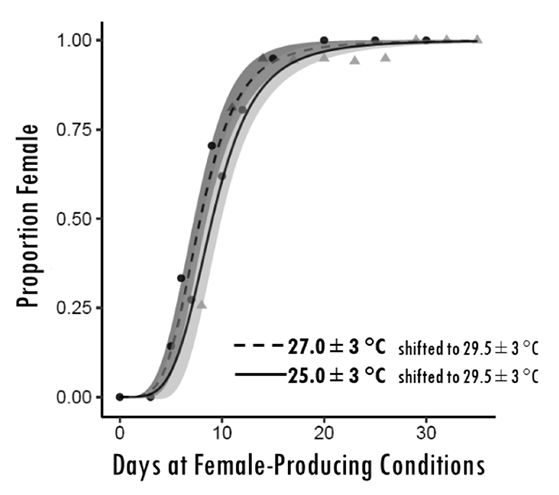
What My Science Looks Like: In Figure 1, Amanda graphed the number of days that turtle eggs were at female-producing temperatures (x-axis) and the percent of turtle eggs that became female (y-axis). 

A data figure that has four panels and show the temperature of the soil across the Illinois turtle nesting season. The x-axis of each panel is time in months. The y-axis shows temperature in degrees Celsius. In each panel there is a black line at 29 degrees to indicate the pivotal temperature. Panel A shows a 23-year average; the average never reaches the pivotal temperature. Panel B shows average temperatures in 1993; there are periods of time when the temperature reaches or passes the pivotal temperature. Panel C shows average temperatures in 2004; the average never reaches the pivotal temperature. Panel 4 shows average temperatures in 2012; between July 1st and August 1st, temperatures are consistently above the pivotal temperature. This figure shows that temperatures naturally fluctuate, but temperatures are the highest in 2012 and heatwaves are longer in duration and higher in amplitude.
Figure 1. The proportion of female turtles produced when eggs are exposed to 0-35 days of female-producing temperatures. Figure adapted from Carter et al. 2019. 

For the experiment described in this paper, the male-producing temperatures used was 25 ± 3°C (dashed line). A similar experiment was done the year before but the male-producing temperature was 27 ± 3°C (solid lines). Both male-producing temperatures (dashed and solid lines) follow the same shape on this graph. Because of this, Amanda concluded that the number of days at female-producing temperatures is an accurate way to predict the number of female turtles produced. 

In Figure 2, Amanda also graphed the CTE (x-axis) and the percent of turtle eggs that became females (y-axis). 

Figure 2. The predicted number of females produced using CTEs. Figure adapted from Carter et al. 2019. 

In her first figure, Amanda was able to show that both male-producing temperatures (dashed and solid lines) resulted in the same sex ratios. But in this figure, she shows that they have different CTEs. Even though they had different CTEs, they resulted in the same amount of females. This means that CTEs are not a good way to predict sex ratios

The Big Picture: Climate change is a growing threat, and it is important to understand how animals will respond to these changes. Amanda studies the effect of temperature on animals with TSD to help us predict how species will respond to future climates. This research also helps with our conservation efforts. The more we know about how the environment will affect species, the better we can help to curb these effects. 

Decoding the Language: 

Climate change: A change in global or regional climate patterns, often seen as major changes in temperature or precipitation. 

Constant Temperature Equivalents (CTEs): A tool used to guess the number of females produced when eggs are exposed to temperatures that go up and down, similar to how temperatures go up during the day and down during the night. CTEs are calculated using formulas based on what you use as the nighttime and daytime temperature. For example, Amanda used male-producing temperatures of 25 ± 3°C. Using the CTE calculation, she would expect to get the same number of females as if she incubated the eggs using a constant temperature of 25.98°C. 

Female/Male-producing temperatures: Female-producing temperatures are higher/ warmer temperatures that cause red-eared slider turtles to become female. Male-producing temperatures are lower/colder and cause these turtles to become male.

Incubation: The process of keeping an egg warm enough to develop until hatching. In the context of Amanda’s research, a male-producing incubation temperature is approximately 26°C and a female-producing temperature is approximately 31°C. 

Physiology: A branch of biology that studies how different parts of the body carry out chemical and physical functions.

Sex ratio: A ratio that compares the number of males to the number of females in a given population. For example, a 1:1 ratio means the number of males and females is the same and that 50% were male and 50% were female. The sex ratio is important because without enough males and females, the population may decline because there will be fewer opportunities to mate and produce offspring. 

Learn More: 

Temperature-dependent sex determination

Synopsis edited by: Madison Rittinger, M.S. (Anticipated Fall 2021), and Anthony Breitenbach, PhD (Anticipated Spring 2021), School of Biological Sciences, Illinois State University.

Download this article here

Please take a survey to share your thoughts about the article!