Nature as an ally in the fight against drug resistant superbugs

Featured Scientist: Juan Canchola (he/him/his) Bachelor of Science (Anticipated: Spring 2021), School of Biological Sciences, Illinois State University

Two pictures of Juan. One is a picture of him shaking hands with another man, as if he had just received a scholarship or award. The other is a picture of him in the lab. He is filling a balloon with a gas.
Juan at the Illinois State University 6th annual Charles Morris STEM Social (left) and adding a chemical to a reaction flask in the lab (right).

Birthplace: Bloomington, Illinois

My Research: I work in the Mills Medicinal Chemistry research lab, where we study the development of antibiotics from natural products. Natural products are chemicals that occur in nature. Our goal is to create an antibiotic that can be used to fight against antibiotic-resistant bacteria.

Research Goals: I’m very interested in infectious diseases and in Medicinal Chemistry. I would like to continue in research involving both of these fields.

Career Goals: I’d really like to continue research in a M.D/Ph.D. program, but my ultimate goal is to be a dedicated scientist who contributes to the fight against infectious diseases. 

Hobbies: In my free time, I love to work out, play with my dog, and binge watch cooking shows and anime. 

Favorite Thing About Science: I really like science because it is an essential and enjoyable field of study. Science has been society’s number one tool to fight off dangers like disease and illness, but it is also very interesting to study and enjoyable to practice. 

Organism of Study:  We studied and synthesized Anaephene A and B, which are two natural products that can be used to make antibiotics. Anaephene A and B were isolated from a marine cyanobacteria (Hormoscilla sp., Oscillatoriales) by a team of marine biologists off the coast of Guam.
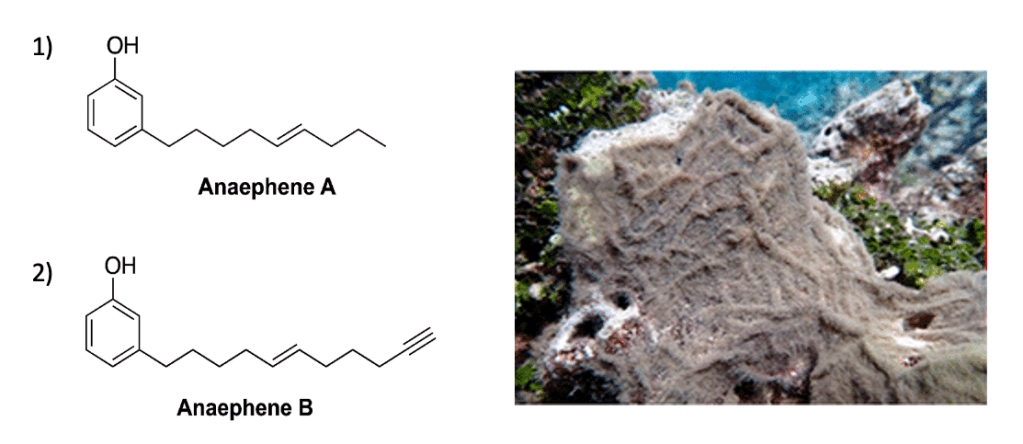
Two images. One has the chemical structure of Anaephene A and Anaephene B. The other has a picture of grey marine cyanobacteria.
The two natural products that we synthesized, Anaephene A and B (left). The marine cyanobacteria (Hormoscilla sp., Oscillatoriales) from which the natural products were isolated (right).

Field of Study:  Medicinal Chemistry

What is Medicinal Chemistry? Medicinal Chemistry is a field of research that uses techniques and knowledge from various fields of chemistry and biology to make medicine. In the research lab I work in, we mainly use organic chemistry and microbiology. Organic chemists study the process of making compounds, while microbiologists study small living organisms, like bacteria. In my work, I use laboratory techniques from both fields to try to make antibiotics out of natural products.

Check Out My Original Paper: “Synthesis of the Cyanobacterial Antibiotics Anaephene A and B” 
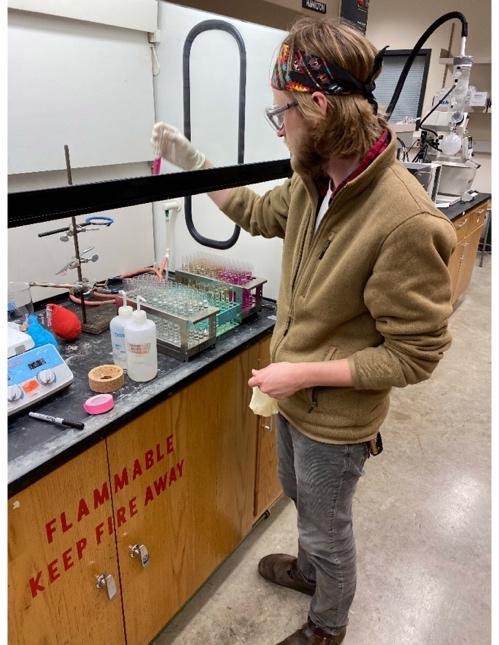
A picture of David pipetting chemicals under a fume hood.
 David Kukla looks for his desired chemical after purifying a reaction mixture.

My Team: I work with Dr. Jonathan Mills in his medicinal chemistry research lab. At the time of this research, Dr. Mills had just arrived at Illinois State University and the only members of the lab were me and a fellow undergrad, David L. Kukla. David is now a graduate student in the Mills Lab. Under the guidance of Dr. Mills, I made Anaephene A and David made Anaephene B. Dr. Mills grew the bacteria and tested our compounds against them. Once we had results, a team effort was made to assemble the data in a more organized format. Dr. Mills handled writing and editing for the paper. David and I helped to proofread so that we could become familiar with the process of turning data into a scientific paper.

Research At A Glance: In our study, we made two chemical compounds that were effective at killing antibiotic resistant bacteria. The compounds that we used were Anaephene A and B. These are naturally made by a type of marine cyanobacteria and are considered natural products. They were selected because other researchers had found them to be biologically active against some strains of bacteria. Our goal was to find a way to make these natural products in the laboratory and see if they were effective against antibiotic resistant bacteria. We were able to make Anaephene A and B and tested them against three strains of bacteria. We exposed the bacteria to different levels of Anaephene A and B to find the smallest amount needed to prevent their growth. Both compounds did well against all three strains of bacteria, including a superbug known as Methicillin-resistant Staphylococcus aureus (MRSA). Anaephene B performed better than Anaephene A, but both were very effective against MRSA

Highlights: To see if Anaephene A and B could be used against our strains of bacteria, we conducted Minimum inhibitory concentration assays (MICs). The three bacterial strains that we used were Bacillus cereus (B. cereus), Staphylococcus aureus (S. aureus), and MRSA. We used B. cereus and S. aureus because they are a common cause of infections in humans. We used MRSA because it is an infectious bacterium that is resistant to many antibiotics. We used the MICs to find the minimum amount of Anaephene A and B needed to destroy the bacteria and/or prevent bacterial growth. Compounds that have this effect on bacteria are considered biologically active. A smaller MIC value means that the compound is more potent because less is needed to destroy the bacteria. The purpose of the MIC assay was to confirm that the two natural products were biologically active and to determine if they could be effective against antibiotic resistant bacteria, like MRSA. Our results showed that both compounds were biologically active against the bacterial strains tested. Both of the natural products also succeeded in inhibiting the growth of MRSA at fairly low MICs. Anaephene B, in particular, proved to be highly potent as it displayed an MIC of 8 μg/mL against MRSA and the other two strains of bacteria. As you can see from Table 1, Anaephene A and B were significantly less potent than the positive control, Linezolid. Linezolid is an approved antibiotic that has gone through years of development and optimization. Anaephene A and B, on the other hand, are natural products that have not been modified. The physical structure of these compounds contributes to their biological activity. Investigating the structure of these compounds could help us determine exactly what causes them to have antibiotic properties. 
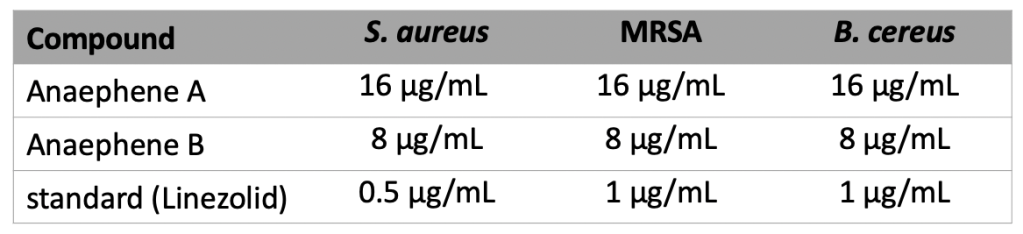
A table of MIC values for the chemicals tested. Anaephene A has an MIC of 16 micrograms/mL for each bacteria. Anaephene B has an MIC of 8 micrograms/mL for each bacteria. Linezolid has an MIC value of 0.5-1 micrograms/mL for each bacteria.
Table 1. MIC values of Anaephene A, Anaephene B, and Linezolid (a standard synthetic antibiotic).

What My Science Looks Like: To synthesize Anaephene A and B, we had to look at their physical structures. The structure of the compounds helped us to determine the reactions or steps we needed to use to make them (Figure 1).
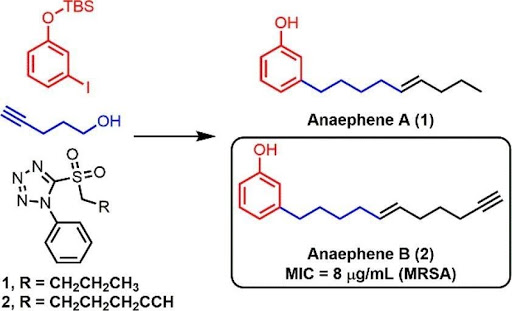
A chemical reaction that ends with Anaephene A and Anaephene B. The figure highlights the MIC of Anaephene B, 8 microgram/mL against MRSA.
Figure 1. Summary of the main pieces used to make Anaephene A (1) and Anaephene B (2). The more potent compound, Anaephene B (2), is boxed with its reported MIC value. Figure adapted from Kukla et al. 2020.

To make Anaephene A and B, we looked at similar compounds as a reference. We studied the reactions used to make those compounds and used that information as a guide. Through a process of trial and error, we found the arrangement of steps, or the synthetic pathway, that would successfully make Anaephene A (1) and B (2) in 5 steps (Figure 2).

A five step chemical reaction that leads to the precursor that makes both Anaephene A and B.
Figure 2.  The complete synthesis of Anaephene A (1) and Anaephene B (2). This is the synthetic pathway used to make both of the natural products.  Figure adapted from Kukla et al. 2020.

The Big Picture: Many bacteria are evolving resistance to commonly used antibiotics. Bacteria that are resistant to many antibiotics are called superbugs. As superbugs become more and more drug-resistant, the number of antibiotics that can be used against them is decreasing. Since we have a limited number of approved antibiotics, health care professionals are forced to use the same ones over and over again. This is what can lead to antibiotic resistance. Some experts think that if we do not develop more antibiotics soon, common bacterial infections may turn deadly because we will not have the drugs needed to treat them. 

Many of the antibiotics that we use for medicine are made using the same synthetic pathways or they use the same mechanism of action. This means that not only are we running out of antibiotics, but we are also running out of ways to make them. To combat the rise in antibiotic-resistant bacteria, we need to look for new synthetic pathways and mechanisms of action. Most of our successful drugs come from natural products, so nature may be the best place to look for a solution. Biologically active natural products show a lot of potential because they are usually made by an organism to defend against pathogens. Therefore, natural products tend to be harmful for pathogens but not the organism itself.

In our research, we have made two natural products, Anaephene A and B, which can kill both common bacteria and antibiotic resistant bacteria. Anaephene A and B could potentially aid us in the development of new antibiotics since they were found to be biologically active against the bacterial strains tested. This is only the very beginning and there could still be some unknown drawbacks. For example, we don’t know what effects Anaephene A and B have on the human body. We also don’t know what the mechanism of action is. This is crucial information for antibiotic development, so it is clear that much more work lies ahead. Overall, we have identified natural products that kill antibiotic resistant bacteria and found a way to make them in the laboratory. Much more research is required to determine if these compounds can be developed into antibiotics safe for use in humans, but we’re off to a good start.

Decoding the Language: 

Antibiotic: A substance that kills or prevents the growth of microscopic living organisms, like bacteria. We commonly use antibiotics in medicine to treat bacterial infections.

Antibiotic resistance (drug-resistant): Antibiotic resistance refers to bacteria that have developed the ability to survive the antibiotics that were designed to kill them. Antibiotic resistance is a global issue. As bacteria become increasingly resistant to many antibiotics, the number of antibiotics that can be used for treatment decreases. Scientists fear that in the near future we may completely run out of antibiotics that can be used to fight off bacterial infections. 

Bacillus cereus (B. cereus): B. cereus is a common strain of bacteria that is often found in soil and vegetation and can also be present in foods. It can multiply quickly at room temperature and is a common cause of “food poisoning”, an intestinal illness that can cause nausea and/or vomiting. 

Bacterial strains: Bacterial strains describe subtypes of bacteria that vary in appearance, structure, and function.

Biological activity:  Biological activity is a term used in medicinal chemistry to describe the negative or beneficial effects that a compound has on a living organism. In our case, the compounds negatively affect bacteria, therefore they are biologically active.

Chemical compound: A chemical compound (referred to as just compound in chemistry) is a substance made from two or more elements in a fixed position.

Marine cyanobacteria: Cyanobacteria is a type of bacteria that is capable of photosynthesis, that is, using light to make energy that supports the growth of the bacteria. These types of bacteria are found in biofilms in the ocean. Biofilms are thin, slimy layers or “films” of bacteria that grow over the surface of rocks, plants, and algae, usually underwater.

Mechanism of action: The mechanism of action describes how a chemical performs its actions. In our study, it describes how our compound is able to inhibit the growth of bacteria.

Medicinal Chemistry: A field of chemistry involving the research, design, and development of chemicals that can be used as pharmaceutical drugs.

Methicillin-resistant Staphylococcus aureus (MRSA)MRSA is a strain of bacteria that has developed resistance to several antibiotics. It can cause ‘staph’ infections that are difficult to treat.Minimum inhibitory concentration assays (MICs): MIC is a test that involves diluting a drug several times to find the lowest amount that will prevent visible growth of bacteria.

Natural products: These are chemicals, or substances, that are found in nature or are produced by living organisms.

Pathogen: A bacteria, virus or other microscopic living organism that can cause disease. MRSA is a pathogen because it can cause disease.

Staphylococcus aureus (S. aureus): S. aureus is a common strain of bacteria, frequently found in the upper respiratory tract and on the skin. This strain of bacteria can cause a variety of mild to severe soft tissue infections and pneumonia but is most known for causing skin infections in hospitals.

Superbug: This is a term used for strains of bacteria, viruses, parasites and fungi that are resistant to most of the antibiotics and other medications commonly used to treat the infections they cause. 

Synthesis: The process of manually making a product through the use of chemical reactions. In this research, we synthesized Anaephene A and B.

Synthetic pathway: A synthetic pathway describes the collection of steps, or the path, used to synthesize a product.

Learn More:

Check out the following sources for more information on the Anaephene natural products and on antibiotic resistance:

Original publication on the isolation of the Anaephene natural products

Article from the World Health Organization (WHO) on antibiotic resistance

Article from the Centers for Disease Control (CDC) on antibiotic resistance

Very interesting and relevant information on antibiotic resistance and Covid-19

Synopsis edited by Ian Rines, PhD Candidate (Anticipated: Spring 2023), School of Biological Sciences, Illinois State University and Brooke Proffitt, B.S. 2020, Illinois State University Alumna.

Download this article here

Please take a survey to share your thoughts about the article!

Are GMOs a threat? Exploring Views of Peru‘s Ban on Genetically Modified Organisms

Featured Scientist: Teddy Dondanville (He/Him/His), M.S. 2018, Department of Anthropology & Sociology, Illinois State University.

A picture of Teddy Dondanville looking into the camera.
A picture of Teddy with a group of student standing in front of a building.
In addition to his research, Teddy worked as a Peace Corps volunteer at the Instituto de  Educación Pública San Martin de Porres. The image above shows a Teddy, fellow teachers, and a small group of graduating seniors on a field trip to the local institute for higher education. The goal was to help students learn more about the college experience. 

Birthplace: Los Angeles, California

My Research: I am interested in the relationships between people and the environment. Specifically, I am interested in agricultural practices, like farming, and how agriculture is used to make food.

Research Goals: In the future, I would like to follow up with the research that I did in Peru on the law banning genetically-modified-organisms (GMOs).

Career Goals: I am currently transitioning away from my career from youth development programming (i.e. before/after school care, summer camps, etc.) in the non-profit sector. Moving forward, I am focused on programming in outdoor and adventure recreation.

Hobbies: I am an avid rock climber & cyclist.

Favorite Thing About Science: In general, I like conducting research and providing evidence that helps me to understand the world. For example, Sociology is a field of study that often examines problems in society. By conducting research and gathering data, I can shed light on problems happening in our communities and help find ways we can solve them.

My Team: Since this was my master’s Capstone Project, the majority of the research was carried out by me, with guidance by my committee. When I decided to publish it, Dr. Michael Dougherty signed on as a co-author and took part in the data analysis and the writing and editing of the final paper. Dr. Mathew Himley also supported this research with his expertise in Peru. Dr. Maura Toro-Morn also helped inform some of the methodological components.

Field of Study: Environmental Sociology

What is Environmental Sociology? Environmental Sociology is a branch of sociology that looks at the relationship between humans and the environment. For example, my research looked at farming culture and politics and how these concepts relate to agriculture.

Check Out My Original Paper: “Porousness and Peru’s moratorium on genetically modified organisms: stakeholder epistemologies and neoliberal science”

A QR code that links to the original publication.
QR code to the original publication

Citation: T.W. Dondanville & Michael L. Dougherty (2020) Porousness and Peru’s moratorium on genetically modified organisms: stakeholder epistemologies and neoliberal science, Environmental Sociology, 6:1, 107-119.

Research at a Glance: My research focused on the ban of GMOs in Peru. I studied the ideas behind different policy approaches towards the ban. I followed the historical development of Law #29811, a law that was designed to temporarily stop the importation and use of GMOs in Peru. Peru is one of three South American countries that has a national ban on GMOs. The main reason for the law was to protect agro-biodiversity. The concern was that natural agricultural products would be outcompeted if GMOs were introduced to the market. However, it was not that simple. I explored the language in Law #29811. Stakeholder groups had different opinions about the ban on GMOs as a result of the vague language used in the law. I argue that the language in Law #29811 was intentionally vague. Through observations and interviews, I examined the impacts of the law on local agriculture and how three stakeholder groups, (1) farmers, (2) academics and activists, and (3) representatives of state understood the law.

I found that the first two groups, farmers and academics/activists, supported the law on a policy level. The local Andean farmers rejected the idea of GMOs, finding them to be expensive and meaningless. They took great pride in their agricultural products, which showed their energy and commitment. Above all, the exemplar quality of the food they grew was important to them.  Non-genetically modified (non-GMO) food is important to farmers. They view it as an expression of hard work and it is grounded in traditional culture and farming practices. Academics and activists also rejected the idea of GMOs, but for a different reason. They believe that GMOs threaten biodiversity. Additionally, preserving biodiversity preserves the traditional livelihood of indigenous farmers with small parcels of land. GMOs can invade non-GMO crop fields and take over native and organic species. GMOs can also introduce allergens and the chemicals used to maintain them can leave toxins in the plants and soil. Some representatives of state did not support the ban and instead approved of the use of GMOs. They sought to benefit the economy by increasing competition in agricultural markets by allowing the trade and use of GMOs. After gaining an understanding of the various stakeholders‘ opinions, my research offered a critique of Law #29811 that was focused on its shortcomings and hidden intentions.

Highlights: For my project, I wanted to understand the real purpose behind the ban of GMOs in Peru. I argued that the ban was never designed to be long term. Law #29811 had a 10-year time limit. There were also many steps written into the law that would allow Peru to adopt GMOs after the 10-year time limit. This is similar to other policies throughout South America. I argue that Peru’s ban serves as an example of neoliberal multiculturalism. The term neoliberal refers to the type of governmental and economic decisions that support free markets and decreased government intervention. Multiculturalism is the practice of accepting and coexisting with people of different ethnicities, cultures, religions, etc. Law #29811 is an example of neoliberal multiculturalism. On the surface, it exists to protect indigenous Peruvian farming culture by banning GMOs. However, the protections offered by this law only create the illusion of multiculturalism. In reality, under the Peruvian neoliberal government, the law seeks to actually further the use of GMOs in agriculture. It recognizes the indigenous agriculture but does not protect it in the long run. We found this through extensive translation and analysis of government documents and through interviews with academics and activists who were focused on agriculture.

What My Science Looks Like: The table below summarizes the policy approaches of the representatives of the state, academics and activists, and famers. It also summarizes how these stakeholder groups have different perspectives, or how they vary epistemologically. Epistemology refers to the study of knowledge. Essentially, how do people know things? It refers to people’s ability to reason, their belief systems, and how they perceive the world. In my study, I found that each stakeholder group views Law #29811 differently based on their own experiences and knowledge of GMOs. I found that representatives of the state and academics/activists have different policy approaches towards GMO use in agriculture. They both agree that competition and economic development are important. They also agree that science (i.e. GMOs) should be used to increase economic development. However, academics, activists, and farmers all support the ban. They are against the use of GMOs in agriculture, but for different reasons.

A table that lays out stakeholder's policy approaches to the GMO ban. Representatives of the law oppose the ban and suggest that GMOs can enhance competition and economic development. Academics and activists support the ban, but still place value in competition and economic development. Farmers support the ban and value hard work and collectivism.
Policy approaches and epistemological views of representatives of the state, academics and activists, and famers toward GMOs. Table adapted from Dondanville et al. 2020.

The Big Picture: My research combines the topics of both GMOs and neoliberalism in South America. I show how modern economic ideas relate to farming and how policy decisions can affect indigenous communities. By using ethnographic and qualitative research techniques, my research serves as an example on how to study GMOs in agriculture. This research is important because it helps to highlight complicated ideas that relate economic development to industrialized agriculture. Like many other countries, Peru is still developing. To fully understand its growth and what the country has been through, I needed to first understand the origin of the country and where it might be in the near future. Research like this combines the perspectives of multiple actors playing a part in a larger scenario. This works to include many voices, especially the voices of those who have been traditionally marginalized. My research gave them a chance to make their voices heard. The data that we collected helps to paint a more complete picture of the complexities involved in an important facet of daily life.

Decoding the Language:

Agro-biodiversity: Also known as Agricultural (Agro) Biodiversity. Biodiversity refers to the variety of living organisms (flora and fauna) in any given ecosystem. Agro-biodiversity refers to the variety of different plant species that are used specifically for agriculture.

Epistemological: The adjective form of “epistemology”: which is the study of knowledge. It seeks to understand what exactly knowledge is, how it is created, and what it actually means. It works towards understanding the ways through which people and cultures come to understand the world around them and form their beliefs.

Ethnographic: Also known as Ethnography. It is the process by which the observer seeks to understand the customs of individual peoples and/or cultures by living in a certain place for an extended period of time.

Genetically Modified Organisms (GMOs): GMOs are living organisms whose DNA is altered to give them specific/desired traits. Usually, agricultural plants are modified so that they are tolerant to drought or to pesticides

Marginalized: People or groups that are treated as insignificant, excluded, or are in the minority.

Neoliberalism: Neoliberalism is an economic ideal that revolves around free and open trade markets, little to no government intervention, and rolled-back regulation of business practices and environmental protections.

Neoliberal Multiculturalism: Multiculturalism is the belief that having diversity of cultures is a good thing. For example, a country should strive to protect and promote the different cultures that make up its population. Under a neoliberal government, multiculturalism is promoted as a strategy to obtain certain political and economic goals and not just for the betterment of the society.

Qualitative research: Qualitative research is a type of research that allows us to classify and describe the characteristics of an individual or culture through collecting and analyzing non-numerical data. This would include observations, videos, recorded audio, or text.

Stakeholder: Someone who has an interest or concern for an issue that is likely to personally affect them. Often, a stakeholder will have a financial interest in the issue.

Learn More:

Illinois State University Department of Sociology and Anthropology

Illinois State University Center for Community & Economic Development, The Stevenson Center

Global international organization committed to support and help communities in crisis OXFAM International, Peru

Peruvian Society of International Law (in Spanish) Sociedad Peruana de Derecho Ambiental

Non- profit organization dedicated to help Andean communities, Center for Social Well Being

Synopsis edited by Maisam Yousef, B.S. 2019, and Elyse McCormick, M.S. Anticipated 2022, Illinois State University.

Download this article here

Please take a survey to share your thoughts about the article!

Timing and continuity of heat waves affects sexual development in a turtle

Featured Scientist: Anthony Breitenbach (he/him/his), PhD in Biology (Anticipated: Spring 2021), School of Biological Sciences, Illinois State University

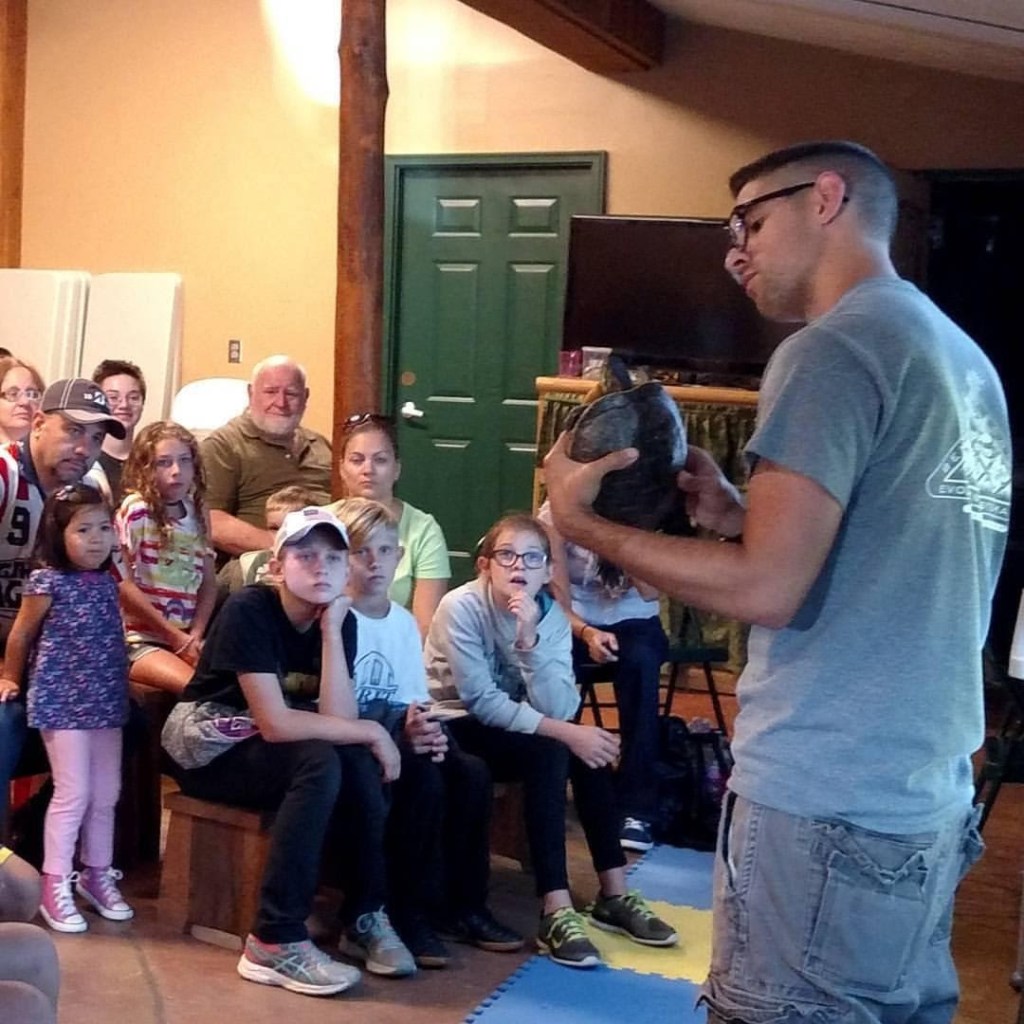
Anthony Breitenbach stands at the front of a room full of children and their parents. He holds a turtle in his hands and the children are watching intently.
Anthony Breitenbach, the “turtle guy”, teaches kids about turtles at Sugar Grove Nature Center in McLean County, IL

Birthplace: Connersville, Indiana

My Research: I’m interested in how hot temperatures affect whether individuals develop as a boy or a girl. This is important because heat waves are predicted to intensify in the future as a result of climate change.

Research Goals: We know a lot about sexual development in humans, but we don’t understand how it is affected by temperature for some organisms like turtles. I wish to continue researching how sexual development happens in nature.

Career Goals: I love to teach. I would love to continue teaching science to multiple different age groups.

Hobbies: I love reading nonfiction history books, playing video games, and listening to rock music!

Favorite Thing About Science: My favorite thing about science is its great purpose: to understand the world around us in a collaborative effort with many different people from many different backgrounds. Playing with fire gets you burned, but playing with science gets you learned!

My Team: I am the first author on this paper, but like all research, this was a cooperative effort. Multiple graduate and undergraduate students participated in the fieldwork by trapping turtles and collecting eggs. Graduate students also helped care for the eggs and the hatchlings. The principal investigator handled the controlled substances necessary for my research.

Organism of Study: Red-eared slider turtle (Trachemys scripta)

A turtle sits in the sand between a set of plants, preparing to lay her eggs.
Nesting T. scripta

Field of Study: Physiological Ecology

What is Physiological Ecology? People in the field of physiological ecology want to know how factors in the environment (like temperature) affect how the body develops.

Check out my original paper: “Using naturalistic incubation temperatures to demonstrate how variation in the timing and continuity of heat wave exposure influences phenotype”

A QR code that links to the original publication.
QR Code to the original publication

Citation: Breitenbach AT, Carter AW, Paitz RT and Bowden RM 2020. Using naturalistic incubation temperatures to demonstrate how variation in the timing and continuity of heat wave exposure influences phenotype. Proceedings of the Royal Society B. 287: 20200992.

Research at a Glance: In animals that have temperature-dependent sex determination, whether the animal is a boy or a girl depends on the temperature while they are in their eggs. In a lot of turtles, warm temperatures cause the turtles to become girls while cool temperatures cause the turtles to become boys. The research that we know this from has been in labs with constant temperatures that never change while the animals are in their eggs. This is different than natural temperatures. We know that temperatures change, usually by increasing during the day and decreasing during the night. My research looks at how temperature affects whether turtles become boys or girls when the temperature is fluctuating, or going up and down in a repeating cycle. My research found that warm temperatures are most likely to cause turtles to become girls if the warm temperatures happen during the middle of development. It also found that more turtles become girls if warm temperatures are continuous, rather than spread out over a longer period of time. Lastly, my research found that two genes respond differently to continuous warm temperatures compared to warm temperatures spread out over a longer period of time. Since heat waves will likely intensify as a result of climate change, the results suggest that more turtles will be girls and less turtles will be boys in the future, which could cause problems for turtle species.  

Highlights: One experiment found that more continuous warm temperatures make it more likely that a turtle will be a girl. To come to this finding, I placed turtle eggs in incubators that let me control the temperature. Eggs were moved between a cooler condition of 25 ± 3 °C and a warmer (heat wave) condition of 29.5 ± 3 °C. Some eggs were exposed to a continuous 12-day heat wave and others were exposed to 12 heat wave days spread out over a longer period of time. A 12-day heat wave made it much more likely for turtles to become girls. It was much less likely for the turtles to become girls when they experienced discontinuous warm temperatures (Figure 1).

A bar graph that shows the probability that a heat wave of 12 or 6 days applied early or late in development will result in a female turtle. The figure shows that a 12-day heat wave applied early in development has the highest probability of creating a female. The bar for a 12-day heatwave is between 0.5 and 0.75 on a 1.0 scale, all others are 0.25 or below.
Figure 1. The horizontal axis shows the different heat wave treatments. The vertical axis shows the probability that a turtle will end up being a girl as a result of the heat wave treatments.

The results show that it is much more likely for turtles to become girls when they experience an early 12-day heat wave when they are in their eggs. If that 12-day heat wave is delayed until later when they are in their eggs, it becomes less likely for turtles to become girls. If a total number of 12 heat wave days is split up into either two 6-day heat waves or four 3-day heat waves, the probability that turtles will become girls drops even more.

What My Science Looks Like:

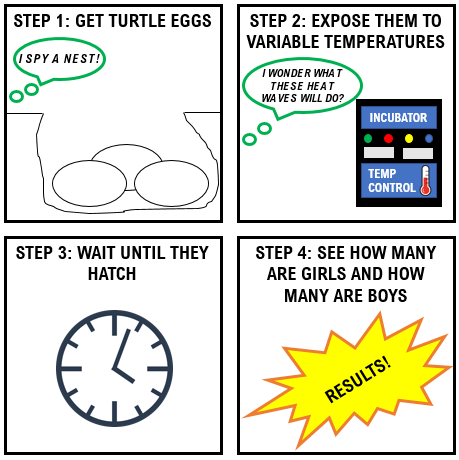
An infographic that describes how Anthony Breitenbach does his research. Panel 1 titled "Step 1: Get Turtle Eggs", shows turtle eggs in the ground. Panel 2 titled "Step 2: Expose Them to Variable Temperatures", shows an incubator. Panel 3 titled "Wait Until They Hatch", shows a clock. Panel 4 titled "See How Many Are Girls And How Many Are Boys", shows the word "Results!".
Pictured here is a brief layout of the steps of my research

My research focuses on controlling the temperatures that turtles experience while they are in their eggs. This is interesting because the temperature in the environment influences whether the turtles become girls or boys. Most of what we know about how this system comes from research done in laboratories using constant temperatures. My research involves exposing turtle eggs to more variable temperatures, such as heat waves. After the eggs hatch, I then check to see how many became girls and how became boys. These results can shed light on how the environment can have long-lasting effects on animals!

The Big Picture: As a results of climate change, heat waves are likely to get hotter and longer. This could result in the production of many more girls compared to boys for animals like turtles and certain other animals. If this happens, then these animals will have a much more difficult time finding mates, which means that the numbers of these animals will go down. Since most research in this field has used constant temperatures, it’s important to further our understanding of how more variable temperatures affect these species.

Decoding the Language: 

Climate change: Climate change refers to changes in climate patterns (such as temperature, precipitation, etc.), particularly as a result of the increased emissions of carbon dioxide and other greenhouses gases starting in the mid to late 20th century.

Ecology: Ecology is a field of science that studies organisms and their relationships with surrounding organisms as well as with their surrounding physical environment

Fluctuate: In the context of this article, fluctuate refers to the temperature that the eggs were exposed to. I used a temperature that would rise and fall repeatedly.

Gene: A gene is a  unit of heredity passed from parents to offspring. Genes normally code for proteins that have certain functions in the body.

Physiological Ecology: Physiological ecology is a field of science that studies the normal functions of the bodies of living organisms. We look at how the body of the organism responds to the environment. 

Principal Investigator (PI): In the context of academia, a PI is a university faculty member that supervises the research of the laboratory. The PI is generally responsible for running the lab, financing the research through grant applications, and training graduate and undergraduate students.

Probability: Probability refers to  the likelihood of something happening. In the context of this article, it refers to the likelihood that a turtle would hatch as a boy or as a girl. 

Temperature-dependent sex determination(TSD): TSD is a type of sex determination system where the environmental temperature that an individual is exposed to during embryonic development (in the egg) determines whether it will develop into a boy or a girl.

Learn More:

To learn more about reptiles/amphibians in general: Vitt, L. J., & Caldwell, J. P. (2014). Herpetology: An Introductory Biology of Amphibians and Reptiles (4th ed.). Amsterdam (Holanda): Elsevier.

You can use this book to learn more about turtles:Ernst, C. H., & Lovich, J. E. (2009). Turtles of the United States and Canada. Baltimore, MD: John Hopkins University Press.

You can use this book to learn more about TSD:Valenzuela, N., & Lance, V. (2004). Temperature-dependent Sex Determination in Vertebrates. Washington, D.C.: Smithsonian Books.

Synopsis edited by: Madison Rittinger (she/her/hers), M.S. (Anticipated Spring 2021) and Casey Gahrs (she/her/her), M.S. 2020, School of Biological Sciences, Illinois State University

Download the PubNavigator article here

Please take a survey to share your thoughts about the article!

Religious/Cultural Identity Politics in “Secular” US and Europe

Featured Scientist: Nick Mullins, M.S. (Anticipated Spring 2020), Department of Politics and Government, Illinois State University

A picture of Nick Mullins, looking directly at the camera and smiling.

Birthplace: Bloomington, IL 

My Research: As a student of political science, I study politics. My focus has been on issues involving globalization, identity politics, nationalism, religion, democracy, global issues, and the international system of nation-states

Research Goals: I would like to continue to study how the nation-state interacts with globalization. Some issues involve identity politics, which seem to be growing in importance. I am also curious about the role of religion and national identity in the future of the nation-state. Other research goals of mine cover global issues such as climate change and migration. 

Career Goals: When I “grow up” I want to enjoy what I do and make a positive impact, but I’m still figuring out exactly how I’ll do that. Some careers I have thought about include: a journalist in independent media covering politics and society, a researcher at a non-profit thinktank, or earning my PhD to become a professor and researcher. 

Hobbies: I tend to get lost in discussions about politics or otherwise. I also love to travel, camp, hike, train my German shepherd dogs (x2), run, bike, and read nonfiction in my spare time. 

Favorite Thing About Science: Science and social scientific studies help us learn about ourselves and the world we live in. I love it. 

Organism of Study: Society, all the people within it, and institutions. 

Field of Study: Political science, global politics and culture 

What is Political Science? The field of political science falls under the category of social sciences. Social science involves lots of reading, observations, and analyses. It often begins with brainstorming an important question, crafting a plan to address the question, collecting data, and then interpreting the results. This research becomes part of a broader conversation in the scientific community and builds on our understanding of the world around us. The aim of political science is to understand or explain problems in politics and government. These problems can span from political ideas to institutions, from the behavior of individuals to groups, and much more. Political scientists will usually focus on a subfield, or a specific area of interest relating to politics and government. 

My graduate program focuses on global politics and culture. In general, my work begins with globalization. Globalization refers to the expansion of global relationships. I am fascinated (and sometimes bothered) by modern politics of liberal democracies. My graduate work has led me to the question of social cohesion, or the extent of trust and cooperation in a society. I am also interested in how national identities can be “broken”, or otherwise no longer collective, and other crises that face democracy. 

Check Out My Original Paper: “Contesting the Secular West: Religio-cultural Identity Politics in Western Liberal Democracies”

A QR code that links to the original publication.
QR Code to the original publication

Citation: N.A. Mullins, Contesting the Secular West: Religio-cultural Identity Politics in Western Liberal Democracies. Zeitschrift für Religion, Gesellschaft und Politik 3.1: 61-74 (2019). 

Research at a Glance: Political discussions often neglect the interaction of secularism, religious, and cultural identities in Western liberal democracies. But these important features must be considered in modern politics. For example, the United Kingdom’s vote to leave the European Union (Brexit) and the election of Donald Trump as the President of the United States each took the world by surprise. In either event, liberal democracies are known for equal rights and non-discrimination. Secularism is the doctrine or policy that separates religion from public life and is common in liberal democracies. Yet religious influence is apparent in both national and world politics. It is often felt as identity politics, with a tendency for people or groups to form political alliances based on a shared identity. Increasing diversity in places like the United States and Europe has renewed debates over culture and national identity. Inclusion is now a matter of question. Societies are shaped by unique histories with secularism, religion and culture. These experiences may help to explain such modern trends. My paper explores this theoretical debate. Liberal democratic values are contested and I draw attention to the relationship between religion, politics, and national identity in the present era. 

Highlights: I wrote the first version of this paper for a seminar in comparative politics on the topic of religion. I drew connections between the cultures of modern society and their historical experiences with religion and secularism and was inspired to write on this topic. For a long time, probably since I was a young teenager, I’ve been a huge nerd for nonfiction books on secularism. I took a graduate seminar with Dr. Ali Riaz here at Illinois State University and it really helped to clarify my research interests. The course was essential to my research in the politics of religion and identity, and in the discovery of my research interests. 

What My Science Looks Like: A stack of books, 25-30 tabs open on my laptop, mind maps, and hand-scribbled notes. 

A picture of a stack of books, in this order: Public Religions on the Modern World by Jose Casanova, Post-Secular Society by Peter Nynas, Mika Lassander, and Terhi Utriainen, Comparative Secularisms in a Global Age by Palgrave Macmillan, Formations of the Secular by Talal Asad, Religion and Politics in South Asia by Ali Riaz, Terror in the Mind of God: The Global Rise of Religious Violence by Mark Juergen-Meyer, Rethinking Secularism by Craig Calhoun, Mark Juergensmeyer, and Jonathan VanAntwerpen, and Secularism and Its Critics by Rajeev Bhargava.
Here are some of the books I referenced when writing my paper. What this picture doesn’t capture is all the articles, reading, notes, and many hours of time put into it! 

The Big Picture: Identity and culture shape the norms, values, and worldviews of individuals and societies. These may be understood as “collective” values or identities around broad ideas, but identities and cultures in societies are often more fragmented. Religions can be supportive of tolerance and other democratic values. They can also take the opposite stance. Secular world views are similar to religion in that way by contradicting tolerance. In either case, religious, ethnic, or cultural minorities may face discrimination from the majority. For example, secularism in France can be restrictive against religious expression and cultural minorities. The reality is that we live in a diverse world. Identity and cultural issues that shape our societies deeply impact our politics. These norms and values are all subject to debate, and it seems to be increasingly so. Additionally, according to the Fragile State Index, social cohesion is worsening in the U.S. I have a hunch this fracturing has something to do with identity politics. The unique histories of societies shape these modern debates and therefore, present politics, which is a key point to remember. 

Decoding the Language: 

Brexit: This term describes the United Kingdom’s vote to withdrawal from the European Union.

Climate change: A change in global or regional climate patterns, often seen as major changes in temperature or precipitation. 

Globalization: This concept has many dimensions. It is generally understood as the expansion of human relations across geographical space. This involves the global economy, politics, culture, environment, and ideology.

Identity Politics: Identity politics places emphasis on individuals and groups. For example, a politician may run for office as a Christian woman and use her identity as a Christian and/or as a woman to appeal to like-minded voters. On the political left, identity politics tends to focus on perceived (or actually) marginalized groups. On the right, it is often about protecting traditional views surrounding national identity, such as, beliefs about race, ethnicity, and/or religion. 

Nation-State: The nation is the political community that legitimizes the state over its territory. Nation-states make up the international system. They are formed by people in a common territory, who may have shared history, traditions, or language. It is territory with a shared cultural and political boundary. 

Secularism: This concept can be simply defined as the doctrine or policy of separation of church and state. It is a basic system of beliefs for how relations between the state and religion are conducted. For example, the political and religious authorities are generally kept separate in a secular state. It can also be understood as a belief system or way of life corresponding to the decline or absence of religious influence on everyday life. 

Social Cohesion: One simple definition of social cohesion is the level of trust in a society, or the extent to which individuals in a society trust one another. It can also be understood as the degree of social stability, how connected we are, and the general wellbeing and representation of individuals and groups within society.

Thinktank: This is an organization with a mission to conduct research to share ideas and/or policy recommendations. 

Learn More: Below are some useful resources relevant to this research and helpful to my current thesis project.

Fragile States Index

Washington Post opinion piece on identity politics

New York Times opinion piece on identity politics

Pacific Standard article on identity politics

Religious extremism

Washington Post opinion piece on political consensus

The Great Regression

United Nations Educational, Scientific, and Cultural Organization (UNESCO) on migration and inclusive societies

Here are some published papers and books on similar topics: 

Identity politics: F. Fukuyama., Identity: The demand for dignity and the politics of resentment. Farrar, Straus and Giroux. New York. 2018. Globalization: M.B. Steger, Globalization: A Very Short Introduction. Oxford University Press. 2009 

Social cohesion: X. Fonseca,S. Stephan, F. Brazier, Social Cohesion Revisited: A New Definition and how to Characterize It. Innovat Eur J Soc Sci Res. 32.2: 231-53 (2019). 

Synopsis edited by: Rosario Marroquin-Flores, PhD (Anticipated May 2022), Illinois State University

Download this article here

Please take a survey to share your thoughts about the article!

Evidence that offspring manage hormones produced by maternal stress

Featured Scientist: Dr. Amanda Wilson Carter (she/her/hers)

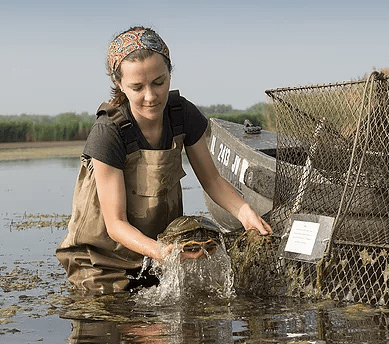
A picture of Amanda Wilson Carter at her field site. She is in a marsh wearing waders. She is next to a canoe, holding a turtle that was just removed from a trap.

Birthplace: New York City, NY 

My Research: I study how animals are affected by changes in their environments. 

Research Goals: I want to understand how changes in temperature affect animal physiology. I would like to be able to better predict how climate change will affect all types of animals. 

Career Goals: I am currently working towards increasing the participation of underrepresented groups in science. My goal is to become a biology professor and researcher. 

Hobbies: Traveling, playing with my dogs, and renovating my 1940’s bungalow. 

Favorite Thing About Science: I love having the freedom to explore questions that I think are necessary and important. Throughout my schooling and career, I have also discovered a passion for mentoring students through independent projects in the lab. There is something very special about watching an undergraduate conduct their first study and transform into a confident and capable young investigator. 

Organism of Study: I study many animals, but my PhD research focused on turtles, mainly the red-eared slider (Trachemys scripta). In my current position, I conduct research on dung beetles. 

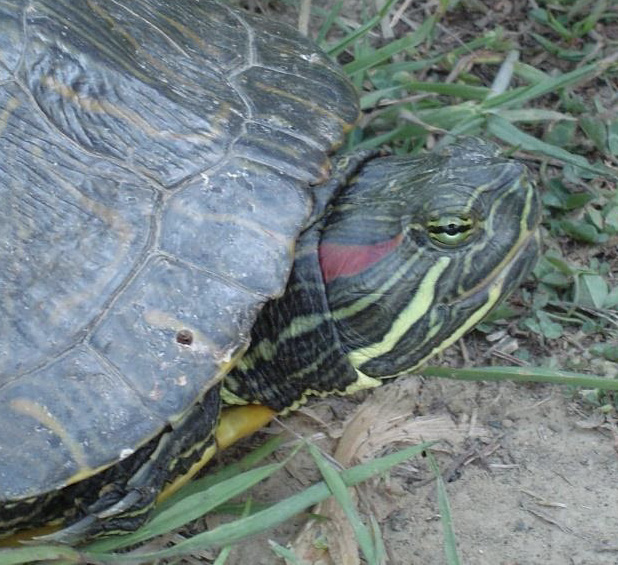
A picture of a red-eared slider turtle on the ground. The turtle has a red band on the side of its head.
Red-eared slider turtle (T. scripta) Image source

Field of Study: Eco-physiology | Climate Change | Plasticity | Development | Parental Effects

What is Eco-physiology? I broadly consider myself an eco-physiologist. I study how the physiology and behavior of animals are affected by their environment (mainly temperature). 

Check Out My Original Paper: “Evidence of embryonic regulation of maternally derived yolk corticosterone” 

A QR code that links to the original publication.
QR Code to original publication

Citation: A. W. Carter, R.M. Bowden, R.T. Paitz, Evidence of embryonic regulation of maternally derived yolk corticosterone. J. Exp. Biol. 221.22 (2018). 

Synopsis written by: Ashley Waring, PhD (Anticipated Fall 2023), School of Biological Sciences, Illinois State University

Research at a Glance: When a mother is stressed, it can affect her future offspring. It can negatively affect them while they are developing and can also affect their survival after they are born. The goal of this study was to understand how maternal stress affects offspring by investigating how corticosterone, a hormone related to stress, affects embryos. In order to test this, turtle eggs from the species Trachemys scripta (red-eared slider turtle) were exposed to high levels of corticosterone. Amanda found out that the embryo will process most of the corticosterone. By the end of her study, less than 1% of the corticosterone was left in the embryo. This shows that, even when a lot of the stress hormone is present, it doesn’t necessarily have a large effect on the embryo. However, if the amount of corticosterone was more than the embryo could handle, some of the embryos did not survive. When embryos did survive and hatch, the hatchling turtles tended to be smaller and have more physical malformations than those that were not exposed to corticosterone. Embryos that had been exposed to corticosterone also took longer to hatch. Amanda’s results show that maternal stress causes a variety of effects on offspring and that too much maternal stress via increased corticosterone can have strong negative impacts. Some of these negative effects exist in traits that are important for survival and reproduction, so maternal stress can harm the offspring’s chances at reproducing successfully. However, since the embryos were able to process some levels of corticosterone, it’s possible that offspring can survive lower levels of maternal stress

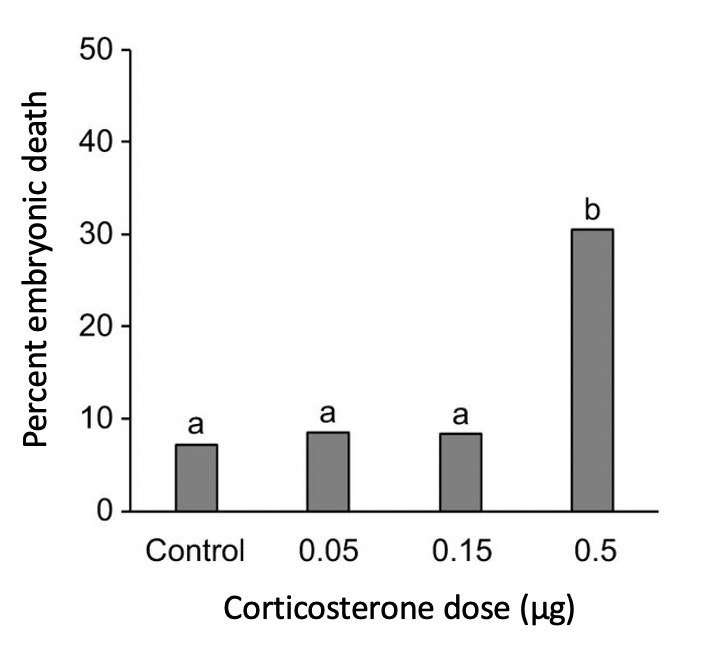
Highlights: Figure 1 shows that, at high levels, corticosterone decreases how many turtle embryos will survive. The bar on the far left, labeled “Control”, shows the mortality rate when no corticosterone is given to the embryo. Each bar to the right shows how many turtles died as the corticosterone dose increased.

A data figure that shows embryo mortality in response to corticosterone. The x-axis shows doses of corticosterone (micrograms) using a control, 0.05 micrograms, 0.15 micrograms, and 0.5 micrograms. The y-axis shows embryo mortality as a percentage. The percent mortality is highest at 0.5 micrograms of corticosterone (30 percent). The percent mortality is significantly lower for the control, 0.05 micrograms, and 0.15 micrograms (all near 10 percent).
Figure 1. The percent of embryos that die after exposure to different doses of corticosterone. The x-axis shows the amount of corticosterone given to the embryo and the y-axis shows the percent of embryos that died. Adapted from Carter et al. 2018.

At low levels of corticosterone (0.05 μg and 0.15 μg) there is almost no change in survival. However, at a high level (0.5 μg), there is a large jump in embryo mortality. This suggests that there might be a threshold point, where the embryo can no longer cope with the amount of corticosterone

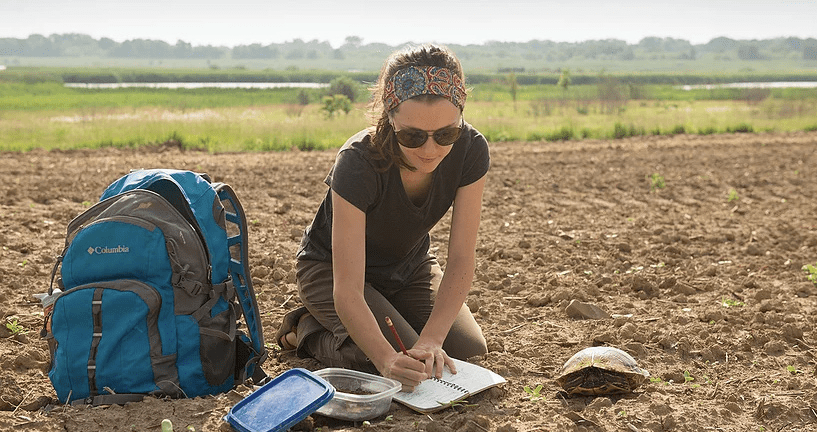
What My Science Looks Like: Below is a picture of Amanda collecting turtle eggs in the field. She looks for female turtles nesting in the dirt, then digs up the eggs that they lay. 

Picture of Amanda Wilson Carter. She is in a dirt field writing in her notebook. There is a turtle to her left.
Pictured above is Amanda doing field work and collecting data during her graduate career at Illinois State University. Picture courtesy of Amanda’s website

The Big Picture: This research provided the scientific community with a better understanding of maternal-offspring relationships. It helped explain the dynamics of stress and how maternal stress may affect the offspring. There are many ways that humans can cause stress in animal mothers, and the potential effects of that are still unknown. However, we now know that there may be a point where the level of stress causes harm. So, moving forward as a society, we need to be aware of how we treat our environment and what stressful effects that will have on animals. 

Decoding the Language: 

Corticosterone: The hormone produced in response to stress. 

Embryo: An unborn or unhatched offspring that is actively growing. In the context of Amanda’s research, the embryo is the developing turtle inside the egg. 

Malformations: Malformation refers to a part of a body that has not formed normally.

Maternal Stress: Maternal stress refers to the stress that a mother experiences during pregnancy. 

Physiology: A branch of biology that studies how different parts of the body carry out chemical and physical functions.

Trachemys scripta (T. scripta): The scientific name for the red-eared slider turtle. 

Learn More: 

Bowden Lab website (former Doctoral Program)

The role of corticosterone in the body

Synopsis edited by: Brie Oceguera Walk, M.S. 2020 and Eric Walsh, M.S. 2020, School of Biological Sciences, Illinois State University

Download this article here

Please take a survey to share your thoughts about the article!

Effects of inbreeding in crickets

Illinois State University dual contributors.

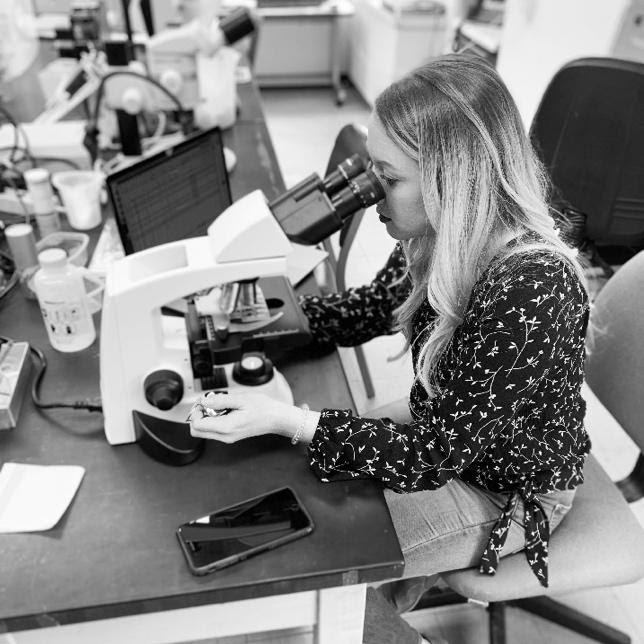
Featured Scientist: Kylie Hampton, M.S. 2020, School of Biological Sciences, Illinois State University

An image of Kylie Hampton at a research laboratory, looking into a microscope.

Birthplace: Chicago, IL

My Research: I am interested in understanding how the female immune system is impacted by mating in decorated crickets. 

Research Goals: I hope to continue to work in the field of Behavioral Ecology because it provides the opportunity to ask really exciting research questions. I am specifically interested in mating behavior and the study of the insect immune system. However, I have diverse research interests and would be excited to gain experience in other fields as well! 

Career Goals: I hope to be a research assistant in a lab that has similar research interests. I really enjoy doing lab work involving microscopy and microbiology but I’d be excited to give field work a try, too! 

Hobbies: I love listening to true crime podcasts, drinking wine, reading, and painting!

Favorite Thing About Science: I love science because it’s an entire field devoted to understanding the world. Every project that I have been a part of has been my personal attempt to contribute something new or to support existing knowledge, which I find to be a really rewarding experience. 

Featured Scientist: Ian Rines, PhD (Anticipated Spring 2023), School of Biological Sciences, Illinois State University

An image of Ian Rines at a research laboratory. There is a transparent box in front of him and room is illuminated in red light.

Birthplace: Charleston, SC

My Research: Male crickets produce compounds that they feed to females during mating. I study how male crickets use these compounds to manipulate female behaviors during and after reproduction. 

Research Goals: I’m interested in the study of animal behavior and am broadly interested in continuing to work with insects. I would like to use molecular techniques to change how genes are expressed in crickets. These techniques should help me to understand what causes certain behaviors. 

Career Goals: I’m not entirely sure what I’d like to do in the future, but right now, I’m hoping to do research in an academic setting.

Hobbies: I enjoy reading, watching movies, and (mild) hiking. 

Favorite Thing About Science: My favorite thing about science is actually doing the science itself. It’s fulfilling to design and carry out experiments to get at an answer to a question. 

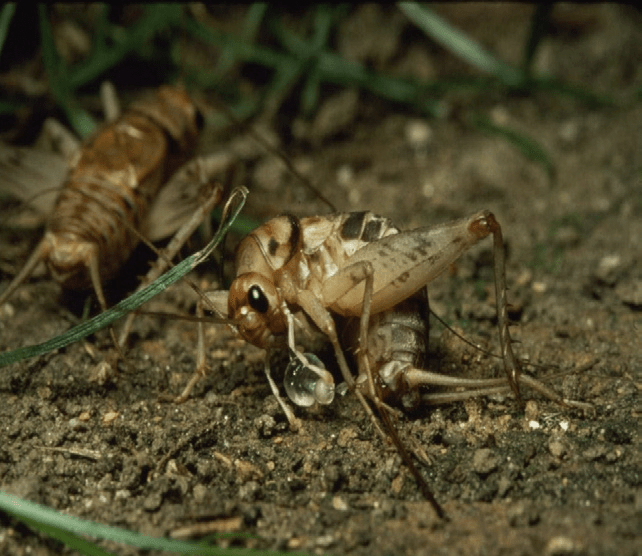
Organism of Study: We study the decorated cricket, Gryllodes sigillatus

An image of a female decorated cricket. She is crouching down to grasp a clear, globular, object attached to her body. The male is in the distance, walking away from the female.
G. sigillatus, or the decorated cricket. Pictured is a male (left) and a female (center). This pair has just finished mating and the female is bending around to remove the gift (the clear capsule she is grasping). 

Field of Study: Behavioral Ecology 

What is Behavioral Ecology? Animal behavior is shaped over time based on ancestry and environmental surroundings. Good behaviors, those that help animals to survive, become more common. Bad behaviors, those that do not help animals survive, become less common. Behavioral ecology is the study of how these behaviors are formed. 

Check Out My Original Paper: “Effects of inbreeding on life-history traits and sexual competency in decorated crickets” 

A QR code that links to the original publication.
QR code to original publication

Citation: S.K. Sakaluk, J. Oldzej, C.J. Hodges, C.L. Harper, I.G. Rines, K. J. Hampton, K.R. Duffield, J. Hunt, B.M. Sadd, Effects of inbreeding on life-history traits and sexual competency in decorated crickets. Anim. Behav. 155: 241-248 (2019). 

Research at a Glance: This paper presents the results of two undergraduate research projects from several years ago. We helped to write the results of their work for publication. We studied how inbreeding affects mating and offspring production in decorated crickets. The crickets were originally collected in New Mexico in 2001. They were mated several times to siblings to create genetically distinct lineages of crickets. To see the impact of extreme inbreeding, we measured the number of offspring that the female crickets produced. Not surprisingly, we found that inbred crickets had fewer offspring. Here, inbred crickets were from the lineages that experienced inbreeding. These offspring took longer to hatch and grow into adults. We also did another experiment to see how inbreeding impacts mating success. From that study, we found that inbred males are less successful at completing their steps in mating, which involve attaching a sperm package to the female’s genitalia. Surprisingly, we found that inbred females preferred inbred males from within their own line, that is, the males that were most closely related to them. This result seemed to contradict all the previous results found in the literature, which indicated that inbreeding had negative effects in these crickets. In general, inbreeding is considered a bad strategy for reproduction, as it can lead to inbreeding depression. Inbreeding depression is a reduction of reproductive output due to mating between relatives. 

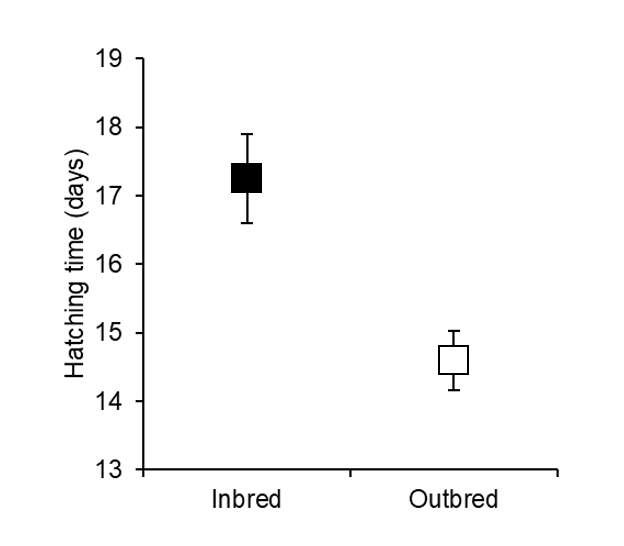
Highlights: Experiment 1: In the first experiment, we examined the effects of inbreeding on the offspring. We looked at hatching and development times, the number of offspring produced, the offspring size, and various other outcomes of mating. In Figure 1, we compared the number of days that it took to hatch for inbred and outbred crickets. Here, outbred crickets are from lineages that did not experience inbreeding. We found that inbred crickets take longer to hatch. 

Figure 1. Hatching time of inbred and outbred offspring. The x-axis shows whether the crickets were inbred or outbred, while the y-axis is the average number of days that crickets took to hatch. Hatching time was the time from when the egg was laid to when the cricket emerged from the egg. Figure adapted from Sakaluk et al.2019.

In Figure 2, we compared the number of offspring that were produced from inbred and outbred crickets. We found that inbred crickets have fewer offspring than outbred crickets. 

Figure 2. Number of offspring from inbred and outbred matings. Again, the x-axis shows whether the crickets were inbred or outbred. The y-axis is the average number of offspring produced by females. Figure adapted from Sakaluk et al. 2019. 

In Figure 3, we looked at the amount of time that it took male and female offspring to develop into adults because sex is known to affect development time. We then compared development time for inbred and outbred crickets. We found that, regardless of sex, inbred crickets took longer to develop into adults. Overall, these results show that inbreeding can have negative impacts on the cricket offspring. 

Figure 3. Development time of inbred and outbred offspring by sex. The x-axis shows the sex of the crickets, while the y-axis indicates the average development time in days. Development time was characterized by how long it took crickets to reach sexual maturity. Figure adapted from Sakaluk et al. 2019.

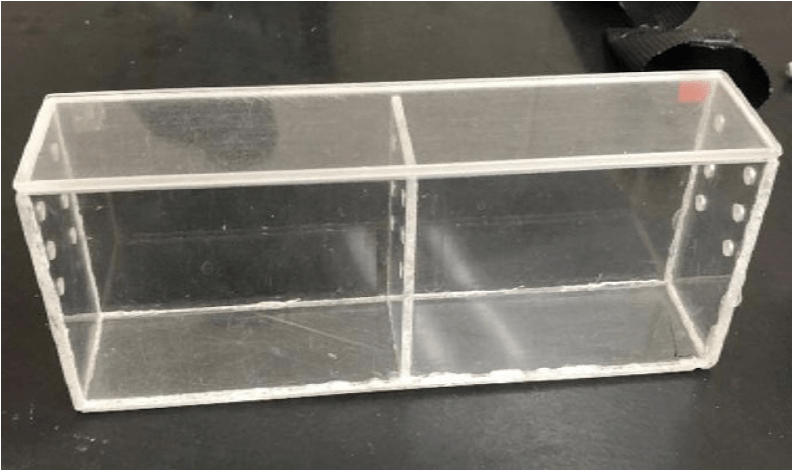
Experiment 2: Our second experiment, where we studied the effects of inbreeding on mating success, yielded very surprising results. We observed the behaviors of several cricket mating pairs. We paired inbred males with inbred females and outbred males with outbred females, then watched them mate. Next, we paired inbred males with outbred females and outbred males with inbred females. We did this to make sure that we had all possible mating combinations (Table 1). To observe mating, we placed males and females into small plastic containers in a dark, warm room. We had the room illuminated by red light because crickets can’t see red light and it allowed us to observe them. 

A table of Mating Pairs. Pairs are as follows: 1. Inbred female by inbred male, 2. Inbred female by outbred male, 3. Outbred female by inbred male, and 4. Outbred female by outbred male.
Table 1. Layout of all mating combinations we observed. 

To successfully mate, male crickets must attach the sperm package to the female. We found that inbred males had a lower chance of successfully attaching the sperm package, regardless if they were paired with inbred or outbred females. We think that inbred males are just bad at mating. This is because previous research shows that males are more likely to experience the negative effects of inbreeding when it comes to the steps in mating. 

Surprisingly, inbred females were more likely to mate with inbred males. Given these results, we cannot simply conclude that “inbreeding is bad”, because inbred females seem to prefer mating with inbred males. While our experiments don’t tell us why this is happening, we have several ideas. Our inbred lineages of crickets have been isolated within their inbred lines from a long time. It is possible that females don’t recognize males from outside of their lineages. They may not see these outsider males as acceptable mates because they are only ever exposed to one type of male, that is, their inbred counterparts.

What My Science Looks Like: The image the below is a mating chamber. We illuminate the room in red light, then observe the mating behavior through this observation chamber.

An image of the cricket mating chamber. It is a translucent plastic box with air holes on the sides.
Image of a mating observation chamber. 

The Big Picture: Studying the effects of inbreeding in crickets may not seem like an important thing to research. Our cricket species is not endangered or declining, but the same cannot be said for many other insect species. Substantial declines have been reported in bees, moths, butterflies, dragonflies, and other insects. There are approximately 1.5 million species on our planet, and insects account for more than half of those species. Compared to most vertebrates, it is much harder to determine whether an insect species is declining. When species go into decline, they are more likely to experience inbreeding and this can negatively impact the species. Inbreeding can harm offspring by shortening their lifespans, damaging their health, and reducing their reproductive output. Given these negative effects, we would expect inbred individuals to avoid mating each other. However, our research shows that animals may not always avoid inbreeding. This is particularly important because we also find that inbred males are less successful at mating. Our study has led to surprising results and further unanswered questions. Future research should help to unravel these mysteries, and focus on the effects of inbreeding on multiple traits (such as mating), not just life history traits

Decoding the Language: 

Compound: A chemical compound is made up of two or more elements. For example, table salt (NaCl) is a chemical compound because it is made up of both sodium (Na) and chlorine (Cl). 

Gryllodes sigillatus (G. sigillatus): The scientific name for the decorated cricket.

Inbreeding: Reproduction between closely related animals. 

Inbreeding depression: The reduction of reproductive output due to mating between relatives. 

Life history traits: Traits that may influence the fitness of an organism, specifically those involved in growth, survival, and reproduction. 

Mating success: In the context of our study, mating success refers to the successfully completing all the steps in copulation, starting with a male courting and a female terminating sperm transfer. 

Molecular techniques: A method used to manipulate and understand DNA, RNA, or protein. 

Outbred: In the context of this study, these are crickets that were not subjected to full-sibling matings and were allowed to mix freely. 

Reproductive output: The number of offspring produced by a female. 

Sperm package: To mate, male decorated crickets will attach a sperm package to the genitalia of the female. The package contains a combination of proteins that the female will feed on after it is attached to her body. As she feeds, sperm from the package will enter the female’s reproductive tract. The longer the package is attached to her body, the more likely it is for the female to be fertilized by the male’s sperm. It is in the male’s best interest to successfully attach the package and to make it as tasty as possible. This lengthens the amount of time that the female feeds and the amount of time that the sperm has access to her reproductive tract. 

Learn More: 

Insect decline

Synopsis edited by: Rosario Marroquin-Flores (she/her/hers), PhD (Anticipated Spring 2022), School of Biological Sciences, Illinois State University 

 Download this article here

Please take a survey to share your thoughts about the article!
 

Horoscope haters beware: a turtle’s birthday may decide more than we think

Illinois State University contributor

Featured Scientist: Haley M. Nichols, B.S. 2017, School of Biological Sciences, Illinois State University

A selfie of Haley Nichols in her home.

Birthplace: Okinawa, Japan 

My Research: I studied the role of nesting season and maternal investment on the behavior of juvenile freshwater turtles. 

Research Goals: In the future, I would like to study how maternal nutrition or nesting conditions affect animal development and behavior. 

Career Goals: I would like to work in managing invasive reptile species, particularly in sensitive areas such as the Florida wetlands. 

Hobbies: I enjoy road trips with my fiancé and taking care of our cold-blooded pets and house plants! 

Favorite Thing About Science: My favorite thing about science is learning new things to better understand the world we live in. I think it allows us to appreciate each moment a little more. 

Organism of Study: I work with the red-eared slider turtle (Trachemys scripta). 

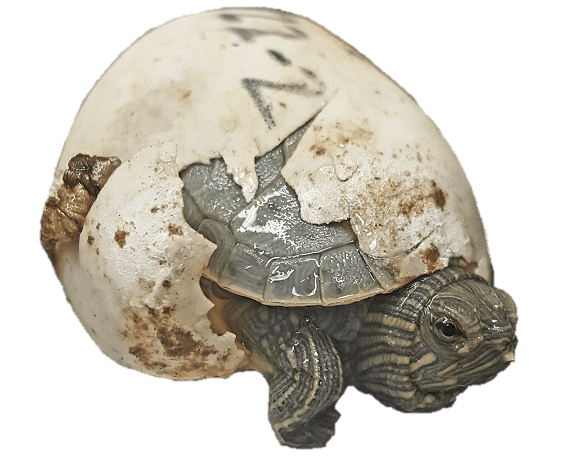
A picture of a T. scripta hatchling half emerged from its shell. The head, left leg, and part of the carapace are visible. The eggshell appears torn and there is a number written on the top of the egg in pencil.
Image of T. scripta hatchling emerging from its shell. 

Field of Study: Animal Behavior & Physiology

What is Animal Behavior & Physiology? Animal behavior studies the way animals interact with themselves, others, and their environment. Their behavior can be affected by both internal and external conditions. Animal physiology studies the internal conditions like hormone regulation, temperature, or metabolic function. External conditions may be access to food and water or the presence of predators. Basically, we look at WHAT animals do and WHY they may be doing it. 

Check Out My Original Paper: “Red-eared slider hatchlings (Trachemys scripta) show a seasonal shift in behavioral types” 

A QR code that links to the original publication.
QR Code to the original publication

Citation: H. Nichols, A.W. Carter, R.T. Paitz, R.M Bowden, Red-eared slider hatchlings (Trachemys scripta) show a seasonal shift in behavioral types. J Exp. Zool. Part. A. 331.9: 485-493 (2019). 

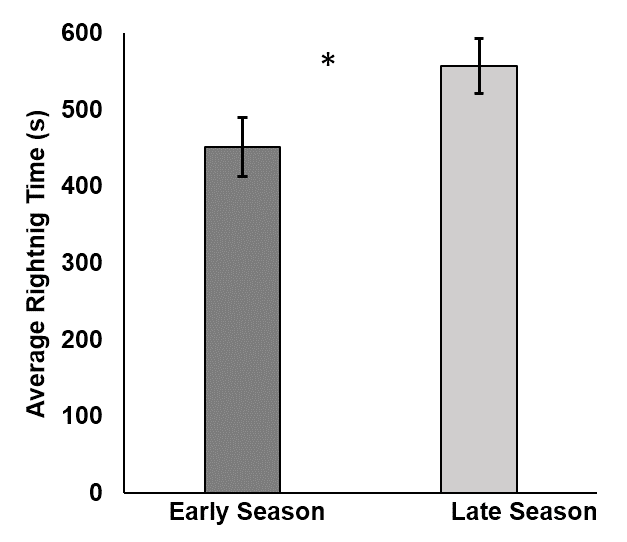
Research at a Glance: Behavioral types can be thought of as an animal’s personality. They are patterns of behavior that repeat. The behavioral type that best supports survival may differ across environments, like seasons. We hypothesized that mothers could use their own behavior and physiology to help their hatchlings survive in the conditions that they are born in. That is, they can help them by making sure that the hatchling behavioral type matches the environment. To test this hypothesis, we measured righting response of juvenile red-eared slider turtles across the nesting season. The righting response is the ability of the turtle to turn itself over onto its abdomen (plastron) after it has been placed on its back (carapace). It is a signal for behavioral type, or “personality”. We studied turtles hatching from early and late season clutches to understand if their personalities change based on nesting season. We found that the nesting season has a significant effect on righting response, with early season hatchlings righting more quickly than late season hatchlings. 

To figure out why this happens, we explored two potential causes: maternal estrogen and maternal investment. From prior research, we know that eggs from late season clutches have more estrogen than eggs from early season clutches. To see if maternal estrogen was causing the difference in righting response, we coated early season eggs with an estrogen hormone to mimic the amount of estrogen found in late season eggs. We found that this did not affect hatchling behavior. To see if maternal investment was causing the difference in righting response, we looked to see if mothers were giving extra energy resources to her eggs when she lays them. We measured the mass of the egg, the hatchling mass, and the mass of the residual yolk on the hatchling’s body. We found that early season eggs have more yolk than late season eggs. We also found that early season hatchlings were larger; they used a higher percentage of their yolk to grow new tissue, rather than just keeping existing tissues healthy. Interestingly, in both seasons, hatchlings that had less yolk also used a higher percentage of the yolk to make tissue, but we found no direct relationship to righting response. Overall, our research shows that behavioral types vary across the nesting season, but it appears that neither maternal estrogen nor maternal investment directly leads to this change. 

Highlights: We we were able to show seasonal differences in the red-eared slider turtle (T. scripta) righting response between seasons, but were not able to determine its cause. We showed that early season turtles are given more yolk and use more of this yolk to grow tissues than late season turtles. We were able to determine the amount of yolk given to each hatchling by measuring the yolk from one egg of each clutch shortly after they were laid. After hatching, we measured the mass of each turtle and the mass of their remaining yolk. We then used statistical tests to look at the differences between these groups. 

Figure 1 shows the results of our righting response behavioral test. It shows that turtles that came from eggs laid late in the nesting season righted themselves more slowly than those laid early in the nesting season

A data figure that shows the time that it takes a hatchling to right itself, relative to the season in which it was born. It shows that turtles born in the early season took about 450 seconds to right themselves. It shows that turtles born in the late season took about 550 seconds to right themselves.
Figure 1. Hatchling righting response trial. The x-axis shows whether the turtle was laid in the early or late season. The y-axis shows the amount of time, in seconds, that it took for the hatchling to turn itself over. Adapted from Nichols et al. 2019. 

What My Science Looks Like: The photo below shows the arena that we used during the righting response trial. The turtles in the top left corner cell and center cell have completed the desired behavior: they were able to turn from the carapace (back) to the plastron (abdomen). Each turtle is given a unique number based on their egg and clutch. We took photos of the plastron of each individual to verify the identity of the hatchling. 

A picture of the righting response trial arena. It is an aerial view of a 3 by 3 grid of small cardboard boxes, each with an open top. Each box has a hatchling inside it. The top left and center box have turtles that are on their feet. All other boxes have turtles that are on their backs.
T. scripta in the trial arena. 

The Big Picture: My research is important because it helps us understand how animal behaviors and physical responses form. We used a species that is sensitive to the environment. Knowing how the environment shapes the body and behavior can help us predict how animals will respond to these changes. 

Decoding the Language: 

Behavioral types: A pattern of behavior in an animal. 

Carapace: The top part of a turtle’s shell. 

Clutch: A group of eggs that are laid together at the same time by a single female. 

Estrogen: One of the primary female hormones; previous studies show it increases in eggs over the nesting season, causing more females in later clutches (Carter et. al 2017, see below).

Maternal investment: The services a mother provides her young, such as, provision of food, care, and protection.

Nesting season: The time of the year eggs are laid. For my species there is an early nesting season (late May to mid-June) and a late nesting season (mid- June to late June). 

Residual yolk: The unused yolk remaining after turtle hatching. 

Righting response: The behavior of turning oneself over from carapace to plastron (the “right” position for walking etc.).

Plastron: The bottom part of a turtle’s shell.

Physiology: A branch of biology that studies how different parts of the body carry out chemical and physical functions.

Trachemys scripta (T. scripta): The scientific name for the red-eared slider turtle.

Yolk: The yellow-orange, nutrient-rich portion of the egg that supplies food to the developing embryo. 

Learn More: 

Physiology, Neuroscience, and Behavior sequence at ISU

Animal physiology:

Animal behavior

Information about the red-eared slider turtle

A.W. Carter, R.M. Bowden, R. T. Paitz, Seasonal shifts in sex ratios are mediated by maternal effects and fluctuating incubation temperatures. Funct. Ecol. 31: 876–884 (2017). 

Synopsis edited by: Rosario Marroquin-Flores (she/her/hers), PhD (Anticipated Spring 2022), School of Biological Sciences, Illinois State University

Download this article here

Please take a survey to share your thoughts about the article!
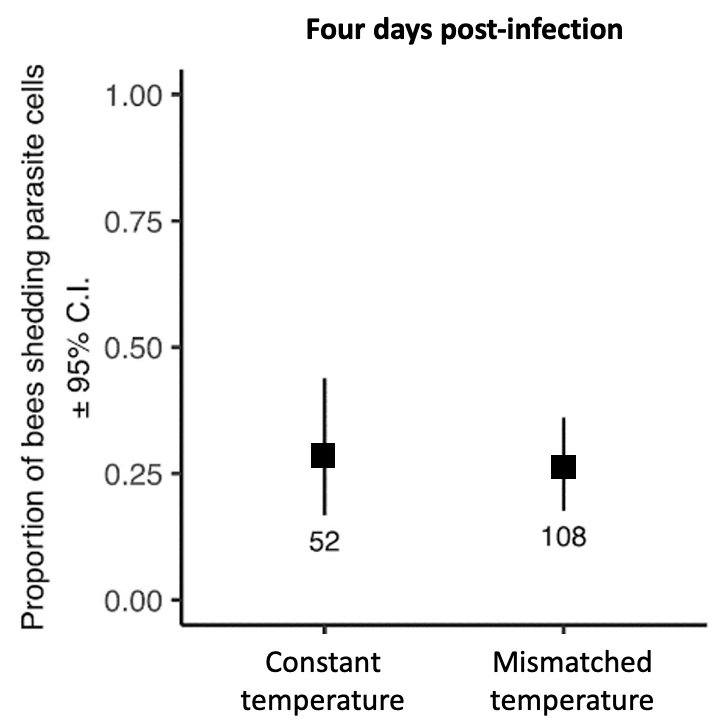
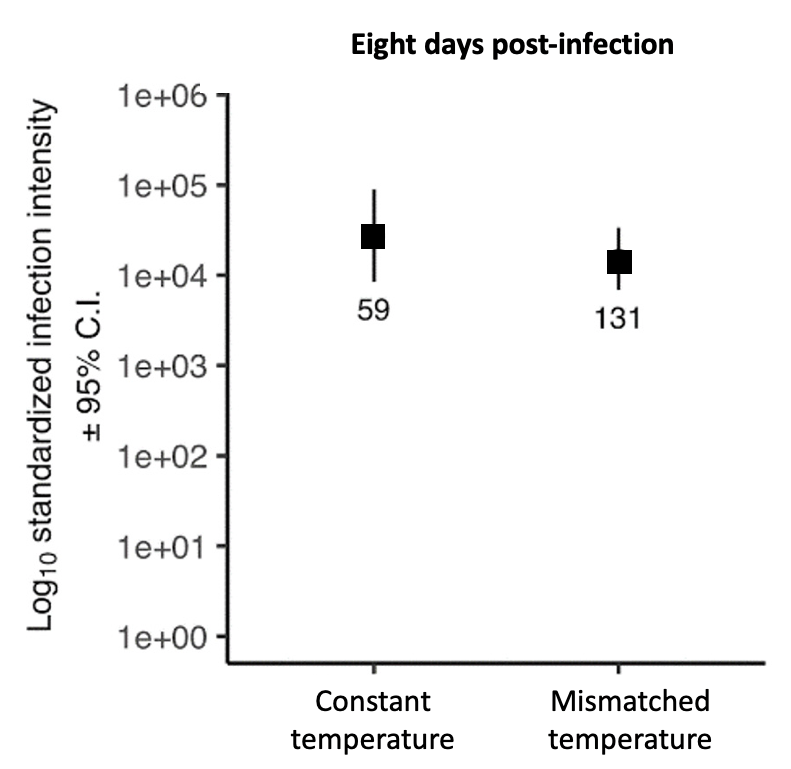
Infection outcomes not significantly affected by thermal variability in a bumble bee host-parasite system

Featured Scientist: Kerrigan B. Tobin, M.S. 2019, School of Biological Sciences, Illinois State University

A picture of Kerrigan Tobin on the slope of a rocky hill, with pine trees on either side. She has one foot planted on a small boulder, with her hands on her hips. She has a butterfly net in one hand.

Birthplace: Normal, IL

My Research: I study how climate change influences bumble bee immune function and survival. 

Research Goals: I want to continue to use a combination of laboratory and field techniques to address native pollinator conservation. I think it’s important to understand how human impacts on Earth may have an effect on the organisms around us. 

Career Goals: I’m currently a lab technician for the USDA, but eventually I’d like to be an Ecology professor, where I can teach and mentor students from various backgrounds about fascinating relationships in nature and how we can support biodiversity. 

Hobbies: Crafts, especially throwing pottery and crocheting. 

Favorite Thing About Science: It’s so satisfying to find evidence and support for a theory! 

Organism of Study: Bombus impatiens, the common Eastern Bumble Bee 

A up-close picture of the Eastern bumble bee. It is holding onto a grain of pollen.
The Eastern bumblebee, B. impatiens 

Field of Study: Ecology

What is Ecology? The study of how living organisms interact with each other and their surroundings. It’s an interesting field because we can study ecology at different scales. We can look at how a single organism interacts with its environment or study how complex networks of species interact in a community. 

Check Out My Original Paper: “Infection Outcomes are Robust to Thermal Variability in a Bumble Bee Host–Parasite System” 

A QR code that links to the original publication.
QR Code to original publication

Citation: K.B. Tobin, A.C. Calhoun, M.F. Hallahan, A. Martinez, B.M. Sadd, Infection Outcomes are Robust to Thermal Variability in a Bumble Bee Host–Parasite System. Integr. Comp. Biol. 59.4: 1103-1113 (2019). 

Research at a Glance: In this paper, we wanted to test whether changes in temperature make it more difficult for a bumble bee to fight off infections. Climate change is predicted to make temperatures more variable. These changes are likely to have an impact on many animals and how they interact with their environments. Living creatures have an optimum range of temperatures where their bodies perform the best. Outside of this range, their bodies cannot carry out important tasks. These ideas suggest that climate change might hurt animals because they will have to survive outside of the range of temperatures they are used to. Some scientists explain this using the “beneficial acclimation hypothesis” or BAH. This idea suggests that animals adjust to their environment, which gives them advantages for survival. For example, animals that live in the desert are particularly good at surviving in desert conditions. But, animals from the arctic are bad at surviving in the desert. On the same line of thought, we wanted to know if bumble bees were better at fighting off infections when they were living at the temperature that they were used to, their acclimation temperature. We wanted to see if bees living in a temperature outside their normal range were more likely to get parasites than bees kept at their normal temperature. To test this, we used the Common Eastern Bumble Bee as a host and a gut parasite that often infects bumble bees, Crithidia bombi

In our experiment, we used bees from four different colonies. Each bee was given one week to acclimate, or get used to, a specific temperature. They were acclimated to 21°C, to room temperature (between 25-26°C), or to 29°C. Next, we gave each bee one of two strains of the parasite, C. bombi. This parasite is commonly found in the gut of the bumble bee. We gave the bees the parasite by mixing C. bombi into sugar water that was fed to them. After parasite exposure, bees were then put in a performance temperature of 21°C, room temperature (between 25-26°C), or 29°C. This means that some bees went back to the temperature that they were acclimated to, but others were placed into a different, mismatched, temperature. At four and six days after parasite exposure, we checked to see if the bees were infected by collecting their feces and looking for parasite cells inside. Eight days after parasite exposure, we froze the bees and measured how intense the infection was. 

We found that the strain of C. bombi matters, because the two strains of parasites did not infect bees at the same rate. We also found that bees from different colonies had a different susceptibility to infection. This means that some bees are more likely to get an infection based on their colony of origin. Finally, we found that constant and mismatched temperatures did not impact whether the bees became infected or how intense an infection became. These results mean that we did not find support for the BAH. Overall, our results suggest that small changes in temperature are not changing the relationship between bumble bee hosts and their parasites. We also showed that some parasites are better at infecting hosts than others, and some colonies are more likely to get infected than others. More work must be done to really understand how climate change might impact bee health, but our study is a good first step. 

Highlights: The goal of this research was to test the BAH in the bumble bee host-parasite system. The BAH says that bees used to one condition, but given an infection with a parasite in different conditions, would have worse outcomes than bees that stayed in constant conditions. We tested this by keeping bees in constant temperatures or letting them get used to one temperature and then moving them to a new temperature. Then, bees that were kept at constant temperature and bees that experienced mismatched temperature were each given a dose of parasites. We screened the feces of each bee at 4 and 6 days after parasite exposure. We measured the intensity of the infection eight days after exposure to the parasite by performing qPCR on the gut of each bee. qPCR is a laboratory method that allows us to estimate the number of parasite cells contained in each bee. 

We compared temperature treatments and infection over time to analyze our results. Figure 1 shows the number of bees that had parasite cells in their feces 4 days after they were infected. On day 4, there was no difference between bees that were kept at constant or mismatched temperatures. 

Figure 1. Infected bees 4 days after C. bombi exposure. The x-axis shows the temperature treatment and the y-axis shows the proportion of bees that became infected. Adapted from Tobin et al. 2019. 

Figure 2 shows the number of bees that had parasite cells in their feces 6 days after they were infected. On day 6, more bees were infected, but there was still no difference between bees that were kept at constant temperature and those that experienced a mismatched temperature.

Figure 2. Infected bees 6 days after C. bombi exposure. The x-axis shows the temperature treatment and the y-axis shows the proportion of bees that became infected. Adapted from Tobin et al. 2019. 

Figure 3 shows the intensity of the infection 8 days after the bees were infected. There was no difference between bees that were kept at a constant temperature and those that experienced a mismatched temperature. 

Figure 3. Intensity of C. bombi infection 8 days after bees were exposed to the parasite. The x-axis shows the temperature treatment and the y-axis shows a measurement of infection intensity. The data was log-transformed to make it easier to interpret. Adapted from Tobin et al. 2019 

Taken together, Figure 1-3 show that temperature did not change whether or not a bee was infected with the parasite or how intense the infection was. This means that we did not find support for the BAH in the bumble bee host-parasite system within the range of temperatures that we tested. More research needs to be done to understand the impact of climate change on this and other systems. 

What My Science Looks Like: The methods that I used in my experiment are presented in Figure 4. The boxes on the left show the temperature that a bee experienced during the 7-day acclimation period. After this, the bees were exposed to one of two strains of the C. bombi parasite. After exposure, bees were either returned to their original temperature (long dashed black arrows, constant), or they were assigned to a different temperature (short dashed gray arrows, mismatched). The boxes on the right side of Figure 4 show the performance temperature. We quantified transmission 4 and 6 days after parasite exposure and we quantified the intensity of the C. bombi infection 8 days after parasite exposure. 

Figure 4. Breakdown of the methods used for the described experiments. Bees started in one temperature (left), were exposed to parasites (center), and were moved to a new temperature before being sampled (right). Adapted from Tobin et al. 2019.

The Big Picture: Human-driven climate change has many effects on earth, but its full range of impacts are not well understood. This research looked at how one part of climate change, thermal variability, will influence a specific host- parasite system. Although we didn’t find support for the hypothesis that we tested, other effects of climate change, like prolonged exposure to high temperature or heavy rainfall, may impact bumble bees and other pollinators. Humans need pollinators to help create the food that we consume, but we are not the only living things that rely on them. Many ecosystems need pollinator services to help plants thrive and produce the fruits that feed many other animals. Pollinator species are in decline and we cannot help them until we understand why it’s happening. Research like mine is important because it helps us to see why pollinators are disappearing. Our work will help to focus conservation efforts. 

Decoding the Language: 

Acclimation temperature: The temperature that an organism adjusts to over time. In the context of this experiment, this was the temperature that bees had 7 days to get used to before we introduced parasites and tested them. 

Beneficial acclimation hypothesis (BAH): The BAH is a hypothesis that suggests that animals that have lived in a particular environment for a long period of time have adapted to that environment. These animals are particularly suited to this environment and will survive better than animals that are from somewhere else. 

Bombus impatiens (B. impatiens): The scientific name for the common Eastern Bumble Bee. 

Climate change: A change in global or regional climate patterns, often seen as major changes in temperature or precipitation. 

Crithidia bombi (C. bombi): The scientific name for the gut parasite that was used to infect bees in this study. 

Constant: The bees that started in one temperature and were shifted to the same temperature later in the experiment experienced a constant temperature. 

Log-transformed: When data are in a format that is hard to analyze or show graphically, scientists can scale their data set by performing a mathematical operation, like a logarithm, to scale the data.  

Mismatched: The bees that started in one temperature, but were shifted to another temperature later in the experiment experienced a mismatched temperature. 

Native pollinator: “Pollinator” refers to any animal or insect that helps to carry pollen from flower to flower. A native pollinator is an animal that provides pollination services to flowers and is local to the area. For example, bumble bees are native pollinators because they naturally occur in the United States. The honey bee is not a native pollinator because these bees were imported into the country. 

Performance temperature: In the context of this experiment, the performance temperature was the temperature that the bee was experiencing when we tested for the effects of the parasite infection. 

Quantitative polymerase chain reaction(qPCR): qPCR is a lab technique where known quantities (or standards) of DNA are amplified at the same time as unknown DNA samples. It is used to estimate the DNA concentration in each unknown sample based on how much the unknown samples were amplified relative to the standards. 

Transmission: Transmission refers to whether or not the bee became infected with the parasite. 

Learn More: 

Pollinator Partnership

U.S. Department of Agriculture pollinator page, Logan, UT (This is where I work!)

Pollinator Conservation Resource Center

The Intergonvernmental Panl on Climate Change (IPCC)

Synopsis edited by: Elyse McCormick, M.S. (Anticipated Spring 2022) and Rosario Marroquin-Flores, PhD (Anticipated Spring 2022), School of Biological Sciences, Illinois State University

Download this article here

Please take a survey to share your thoughts about the article!
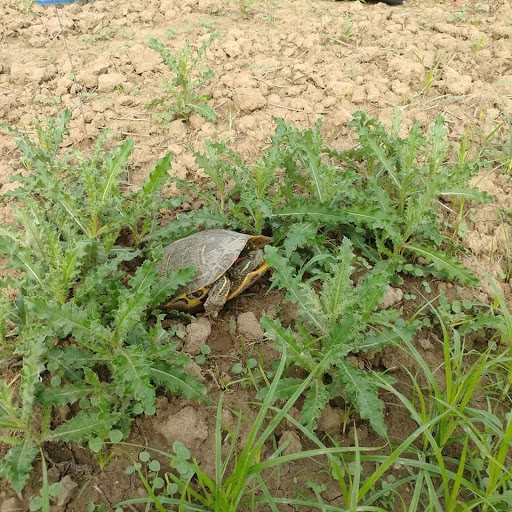
Turning up the heat: how turtle hatchlings respond to environmental temperature

Featured Scientist: Dr. Amanda Wilson Carter 

A picture of Amanda Wilson Carter at her field site. She is in a marsh wearing waders. She is next to a canoe, holding a turtle that was just removed from a trap.

Birthplace: New York City, NY 

My Research: I study how animals are affected by changes in their environment. 

Research Goals: I want to understand how changes in temperature affect animal physiology. I would like to be able to better predict how climate change will affect all types of animals. 

Career Goals: I am currently working towards increasing the participation of underrepresented groups in science. My goal is to become a biology professor and researcher. 

Hobbies: Traveling, playing with my dogs, and renovating my 1940’s bungalow. 

Favorite Thing About Science: I love having the freedom to explore questions that I think are necessary and important. Throughout my schooling and career, I have also discovered a passion for mentoring students through independent projects in the lab. There is something very special about watching an undergraduate conduct their first study and transform into a confident and capable young investigator. 

Organism of Study: I study many animals, but my PhD research focused on turtles, mainly the red-eared slider (Trachemys scripta). In my current position, I conduct research on dung beetles. 

A picture of a red-eared slider turtle on the ground. The turtle has a red band on the side of its head.
Red-eared slider turtle (T. scripta). Image source 

Field of Study: Eco-physiology | Climate Change | Plasticity | Development | Parental Effects.

What is Eco-physiology? I broadly consider myself an eco- physiologist. I study how the physiology and behavior of animals are affected by their environment (mainly temperature). 

Check Out My Original Paper: “Short heatwaves during fluctuating incubation regimes produce females under temperature-dependent sex determination with implications for sex ratios in nature” 

A QR code that links to the original publication.
QR Code to the original publication

Citation: A.W. Carter, B.M. Sadd, T.D. Tuberville, R.T. Paitz, R.M. Bowden, Short heatwaves during fluctuating incubation regimes produce females under temperature-dependent sex determination with implications for sex ratios in nature. Sci. Rep. 8.3: 1-13 (2018). 

Synopsis written by: Elyse McCormick, M.S. (Anticipated Spring 2022), School of Biological Sciences, Illinois State University.

Research at a Glance: Temperature is very important for many parts of biology. For baby turtles, it is essential. Many turtles become male or female based on incubation temperature. This process is called temperature-dependent sex determination, or TSD. Warmer incubation temperatures make females, while cooler incubation temperatures make males. Until now, TSD has been studied in lab settings where the incubation temperature is held constant. However, since temperature doesn’t stay constant in nature, this is pretty unrealistic. Amanda wanted to see what happens to sex ratios when turtles experience real, changing temperatures. She hypothesized that changes in temperature are very important to determining sex in turtles that have TSD. She predicted that turtles are very sensitive to short exposures to temperatures above the “pivotal temperature”, or the temperature that will produce a population-wide 50:50 sex ratio. She also predicted that ovaries will start to grow within a few days of exposure to these warmer temperatures. 

Amanda raised eggs using temperatures that went up and down with daily daytime and nighttime temperatures to mimic what a turtle would feel in nature. She then introduced eggs to short exposures of temperatures above the pivotal temperature to mimic heat waves. She was able to show that sex ratios can be changed by exposure to very short increases in temperature. Amanda used an Illinois population of the red-eared slider turtle, T. scripta, for her research. Under the conditions in this study, T. scripta only needed approximately 8 days of exposure to warmer temperatures to produce a 50:50 sex ratio. At 5 days under the same conditions, 16% of the turtle embryos became female. This shows that even short exposures to warm temperatures can make an embryo become female. Amanda’s research shows that using natural temperatures can lead to a more accurate prediction of turtle sex ratios in nature. Her research also sheds light on another mystery. In Illinois, average temperatures are often so low that female turtles would be unlikely to be born. But somehow, females are still found in the population. Her research shows how female turtles end up in the Illinois population: turtle embryos only need a few days incubating under warmer temperatures to become female. 

Amanda also wanted to see if embryos had the same response to temperature changes across the nesting season. She looked at differences between early and late season embryos to see how long it took under warmer temperatures to make female turtles. Late season embryos required less time at warmer temperatures to produce a 50:50 sex ratio than early season embryos. Mother turtles increase a hormone called estrogen in the yolks of their eggs across the nesting season, which leads to more females later in the season. Thus, late season clutches probably have a ‘head start’ on other embryos because they have more female hormones in their yolk. As a result, eggs don’t need as much time in warmer temperatures to make females. Amanda used the results from her experiments to then develop a mathematical model to better predict sex ratios using natural temperatures measured from the field. This model helps predict the number of male and female turtles based on real field temperatures. 

Highlights: We just learned that females can be made after just a few days at warmer, female-producing temperatures. This finding helps us understand how sex is determined under more natural, changing temperatures. This finding is important because we can now more accurately determine sex ratios in turtle populations using available temperature datasets, like those available through the National Oceanic and Atmospheric Association (NOAA). We are currently experiencing changing global temperatures, where turtle embryos are more likely to experience warm incubation conditions. Being able to predict sex ratios in turtles is important for their conservation. We might be able to accurately identify turtle species or populations that are most at risk of 100% female populations, which would be unable to make more offspring. We can use that information to direct conservation efforts and resources. 

What My Science Looks Like: Figure 1 from this paper is a great example of how different field temperatures can be. Figure 1 reports temperature (y-axis) over the course of the summer nesting season (x-axis) for Illinois turtles. The solid horizontal line shows the pivotal temperature (Tpiv). It shows that, on average, temperatures have not been warm enough to produce females in this population for 23 years. But when you break it down by year, there are bursts temperature warm enough to make females (see 1993 and 2012). In nature, temperature is not constant. Instead, it fluctuates. Amanda had to find a way to test what happens to turtle embryos in their natural environment. She needed temperature data from her study area to show that natural temperatures fluctuate around the Tpiv

Figure 1. Average soil temperatures from Peoria, IL. 
Figure adapted from Carter et al. 2018. 

The Big Picture: Amanda’s research took a more realistic look at TSD. It allowed her to create a mathematical model to predict realistic sex ratios for hatchling turtles. These types of studies allow scientists to better understand what’s happening in nature. Knowledge about how turtles live in the wild is important for more than just improving our understanding of turtle biology. They allow us to understand the wide-reaching effects of environmental impacts, such as climate change, on animals that are extremely sensitive to changes in temperature. Climate change could impact the sex ratios of hatchling turtles in ways we don’t fully understand yet. But this study allows us to start to understand it. Amanda’s model can be used to predict how climate change might affect future generations of turtles. It’s possible that her model can help us understand how climate change will affect turtles, as well as the animals and plants that they interact with. If we can understand how climate change might impact a broad array of plants and animals, we may be able to help lessen its effect on our environment. 

Decoding the Language: 

Climate change: A change in global or regional climate patterns, often seen as major changes in temperature or precipitation. 

Clutch: A group of eggs that are laid together at the same time by a single female.

Embryo: An unborn or unhatched offspring that is actively growing. In the context of Amanda’s research, the embryo is the developing turtle inside the egg. 

Estrogen: A steroid hormone that promotes the development and maintenance of female characteristics in the body. 

Female/Male-producing temperatures: Female-producing temperatures are higher/warmer temperatures that cause red-eared slider turtles to become female. Male-producing temperatures are lower/colder and cause these turtles to become male. 

Incubation: The process of keeping an egg warm enough to develop until hatching. In the context of Amanda’s research, a male-producing incubation temperature is approximately 26°C and a female-producing temperature is approximately 31°C. 

National Oceanic and Atmospheric Association (NOAA): A scientific agency within the United States Department of Commence that focuses on oceans, major waterways, and the atmosphere. 

Nesting season: The duration of time that animals are actively laying eggs. In the context of Amanda’s research, the nesting season lasts from late May to early July.

Temperature-Dependent Sex Determination (TSD): A form of sex determination where the incubation temperature determines whether the developing embryo will become male or female. 

Pivotal temperature (Tpiv): The temperature that produces a population-wide 50:50 sex ratio.

Physiology: A branch of biology that studies how different parts of the body carry out chemical and physical functions. 

Sex ratios: The amount of males compared to the amount of females, or vice versa. 

Trachemys scripta (T. scripta): The scientific name for the red-eared slider turtle.

Yolk: The yellow-orange, nutrient-rich portion of the egg that supplies food to the developing embryo. 

Learn More: 

Illinois Turtles Fact Sheets (Illinois DNR)

NASA’s climate model site

Synopsis edited by: Rosario Marroquin-Flores, PhD (Anticipated Spring 2022), School of Biological Sciences, Illinois State University

Download this article here

Please take a survey to share your thoughts about the article!

Making tiny gold particles to speed up chemical reactions

Featured Scientist: Pascal Nnaemeka Eyimegwu, M.S. 2019, Department of Chemistry , Illinois State University

A picture of Pascal Nnaemeka Eyimegwu in a research laboratory. He is wearing a blue lab coat and safely goggles.

Birthplace: Nkalagu, Nigeria

My Research: I study how to make reactions go faster using nanoparticles.

Research Goals: I would like to continue to study nanoparticles (tiny materials) and how they might be used to speed up chemical reactions. This research would help scientists make medicine more efficiently. 

Career Goals: I want to be a Professor of Chemistry. 

Hobbies: I like to travel and play soccer. 

Favorite Thing About Science: Science is interesting because we can use it to interpret everything around us. It provides solutions to our problems. It’s no wonder that we say “all in nature is chemistry”. 

Organism of Study: Gold nanoparticles 

A series of small dots. To the right is a chemical reaction where phenylboronic acid is converted to biphenyl.
Microscopic image of gold nanoparticles (left) and the chemical reaction that I used them for (right) 

Field of Study: Analytical Chemistry

What is Analytical Chemistry? Analytical Chemistry focuses on identifying and quantifying chemicals. For example, analytical chemists are responsible for making sure that your food and water are safe to eat and drink. Analytical Chemistry has been used to develop tools that can check if drivers are under the influence of alcohol, or to tell the difference between illegal drugs and medicines. In addition, this form of chemistry is used to check the quality of food and drugs to make sure that they are safe. 

Check Out My Original Paper: “Atypical catalytic function of embedded gold nanoparticles by controlling structural features of polymer particle in alcohol-rich solvents” 

QR code to the original publication
QR Code to original publication

Citation: P. N. Eyimegwu, J.H. Kim, Atypical catalytic function of embedded gold nanoparticles by controlling structural features of polymer particle in alcohol-rich solvents. J. Nanotechnol. 30.28 (2019). 

Research at a Glance: The goal of this study was to make stable catalysts that can speed up the chemical reactions used to make starting materials in pharmaceutical industries. A catalyst is a substance that makes a reaction go faster. The type of catalyst that I work with can be recycled multiple times without losing its efficiency, unlike the most common type, which can only be used once. In this research, gold nanoparticles are used as the catalysts. However, these nanoparticles attract each other and need to be stabilized to be used effectively. In my study, I stabilize gold nanoparticles using a specialized polymer, an organic compound used in making plastics. The catalyst that I made was highly stable, reactive, and produced no undesired by-products. The catalysts that I designed in my study can be used to produce important starting materials to organic compounds that are often used in pharmaceutical industries. 

Highlights: The catalyst (gold nanoparticles in a polymer) that I made can be used to produce biphenyl, which is a useful starting material for making many organic compounds. I tried to use many different solvents to make biphenyl. The turning point of my research was in the decision to change the solvent for my catalytic reaction. The first solvent that I tried to use was water, but it resulted in poor yields of my target product, biphenyl. Ethanol was able to solve this problem. 

A. Many gold orbs are contained in a circle. The temperature is below 32 degrees Celsius. An arrow points to a catalyst in ethanol above 32 degrees Celsius (B). In this instance, the circle looks similar to the circle of origin. Another arrow points from A to a catalyst in water above 32 degrees Celsius (C). In this instance, the circle is smaller, and the gold orbs are more compact.

The gold nanoparticles are used as the catalyst. The image on the left (a) shows the structure of the catalyst in water below 32°C. The images on the right show the catalyst in ethanol (b) and in water (c) above 32°C. As you can see, the catalyst in water looks smaller but remains swollen and slightly bigger in ethanol. 

Why was ethanol the trick? Unlike water, ethanol tends to remove the organic compounds that prevent the catalyst from performing well. Additionally, I used a polymer in my reaction. The polymer swells more when it is in ethanol than when it is in water, which guarantees more movement of reactants and products in and out of the polymer. The reaction with water creates a by-product, but when I used the ethanol, the by-product was no longer produced. Finally, I found out that the yield is highest when I used ethanol (Figure 1). This is because ethanol can remove things from the catalyst that hinder the reaction. 

A data figure that shows the amount of biphenyl produced when various solvents are used. Pascal used water, methanol, ethanol, propanol, butanol, and t-Butanol as solvents. The percent yield was highest when he used ethanol (~100%) and lowest when he used t-Butanol (~25%). The yield of biphenyl was ~30% when he used water.

Figure 1. Production of biphenyl using phenylboronic acid as the starting material. The x-axis shows the solvents that I used in the catalytic reaction.The y-axis shows how much biphenyl was made. The orange bars represent the amount of biphenyl that was produced after a reaction in each individual solvent. Adapted from Eyimegwu et al. 2019. 

Next, I wanted to make sure that my catalyst was stable. To do this, I needed to run a test to make sure that my catalyst was recyclable. Being recyclable means that the same catalyst can be used to speed up different batches of reactions without losing its strength. The first, second, and third cycle gave the same yield, but the yield went down on the fourth cycle and went down further on the fifth cycle. I was able to bring it up again after purifying it in water and putting it back into ethanol for the 6th cycle (Figure 2). 

A data figure that shows the percent yield of biphenyl after being used in multiple reactions. The yield stayed near 95% after 3 reactions but dropped down to about 65% on the 5th reaction. Pascal was able to bring the yield back up to 95% after the 6th reaction.
Figure 2. Testing catalyst stability. The x-axis shows how many times the same catalyst was used in different reactions. The catalyst was used for six different reactions. The y-axis shows how much product was made in each cycle. Adapted from Eyimegwu et al. 2019. 

As you can see in Figure 2, the catalyst produced just as much biphenyl after the 6th reaction as it did in the 1st reaction. This means that my catalyst should not be thrown away after one reaction because it will still be useful in another one. 

What My Science Looks Like: The image below has two solutions. The one on the left (A) shows gold nanoparticles stabilized by a polymer, so that they don’t clump together. The one on the right (B) shows the gold nanoparticles by themselves. These are the types of solutions that I work with in my research. 

An image that shows two beakers. The one on the left contains a purple solution that is cloudy and opaque. The solution on the left is the gold nanoparticle in polymer. The one on the right shows a purple solution that is more transparent, almost clear. This one only contains gold nanoparticles by themselves.
On the left (A), gold nanoparticles are inside of the polymer. On the right (B), the gold nanoparticles are by themselves. Nanoparticles are clear. This is because they are more unstable and there was no polymer to prevent other reactions. 

The next image shows the steps that I used to carry out the chemical reaction for my experiment. The goal was to make my target product, biphenyl

The steps necessary to make the catalyst. It starts with a polymer without gold (opaque white solution), then a chemical compound that contains gold is added to the solution (HAuCl4) to create a polymer with gold (a yellow opaque solution). Then, sodium citrate is added to the solution to create the purple opaque solution from the previous figure. This is the solution that goes into the reaction to create biphenyl.
These are the steps that are necessary to use gold nanoparticles to speed up chemical reactions. The first step is the mixing of the polymer and gold solution. The second step is the reduction of gold solution to gold particles. The third step is to use the gold particle to make biphenyl

The Big Picture: Gold nanoparticles are safe and inexpensive. People are working hard to use them to make chemical reactions happen more quickly. My research introduces interesting properties of these nanoparticles: they change their catalytic activity when they are put in a polymer and are introduced to ethanol. The products of these reactions can be used to make medicines. 

Decoding the Language: 

Biphenyl: A useful starting material for making many organic compounds used by pharmaceutical companies. 

Catalyst: Materials that make reactions go faster 

Gold solution: The first state of gold, before it is reduced to form particles. 

Nanoparticles: Particles between the range of 1-100 nm in size. 

Organic compounds: A chemical compound is made up of two or more elements. For example, table salt (NaCl) is a chemical compound because it is made up of both sodium (Na) and chlorine (Cl). An organic compound is any chemical compound that contains carbon. For example, sugar (C6H12O6) is an organic compound. It is made up of carbon (C), hydrogen (H), and oxygen (O). 

Phenylboronic acid: A chemical and the starting material that I used to make biphenyl. 

Polymer: An organic compound used in making plastics and nylon. In my research, I used it to stabilize gold nanoparticles so that the gold nanoparticles would not clump together.

Reactants: The materials that come together to produce another material.

Recyclable catalyst: A catalyst that can be used more than once. 

Reduction: A way of making gold solution to become particle. 

Solvent: A liquid that is used to carry out a reaction or to dissolve a solid material. Water is an example of a solvent. 

Products: The result of a reaction, what we are trying to make. 

Learn More: 

Catalysis

Another research paper on catalysis: P.N. Eyimegwu, J.A. Lartey, J.H. Kim, GoldNanoparticle-Embedded Poly (N-isopropylacrylamide) Microparticles for Selective Quasi-Homogeneous Catalytic Homocoupling Reactions. ACS Appl. Nano Mater. 2.9: 6057-6066 (2019) . 

Synopsis written by: Rosario Marroquin-Flores, PhD (Anticipated Spring 2022), School of Biological Sciences, Illinois State University

Download this article here

Please take a survey to share your thoughts about the article!