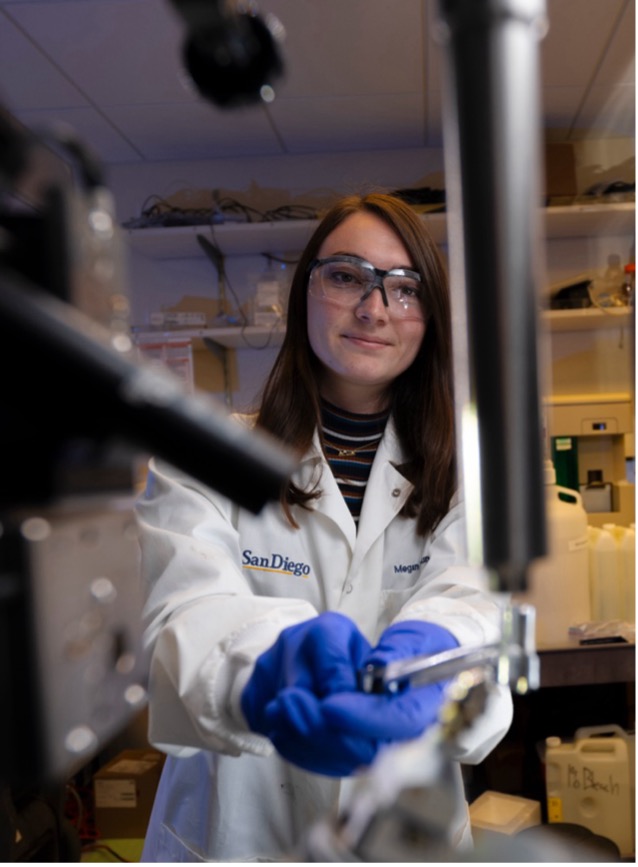
Birthplace: Southern California
My Research: I am interested in how proteins are structured and how their structure influences the way proteins function. It is important to understand the structure of a protein. We can use this information to design drugs to target specific proteins and help to fight diseases.
Research Goals: In the future, I hope to contribute to developing drugs (or therapeutics), for diseases such as cancer. I would like to help create new drugs against cancer-causing proteins.
Career Goals: I enjoy writing about science and teaching new research ideas to different audiences. My goal is to become a scientific and medical writer for doctors, other scientists, and the general public.
Hobbies: In my free time, I enjoy the beach, spending time with friends, and reading.
Favorite Thing About Science: Science is all about explaining things. I enjoy the challenge of learning about a new topic, coming up with new ideas and ways to approach problems, and then explaining the solution to other scientists.
Scientist Upbringing: I come from a family of science teachers. My grandfather was a PhD scientist, and my grandma was an elementary school science teacher. My dad also taught science at a public high school and would come to my elementary school classes and teach science in fun and creative ways. I have always been around science and the pursuit of higher education, and this inspired me to become a scientist.
My Team: I work in a lab at the University California – San Diego. The lab is made up of other structural biologists. I also collaborate with other labs at different institutions and small companies. This helps to expand my horizons for how my research can impact change.
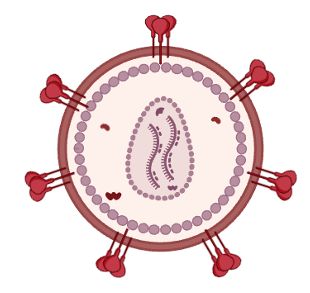
Organism of Study: Human immunodeficiency virus (HIV)
Field of Study: Structural Biology
What is Structural Biology? Structural biology is the study of how proteins look. Proteins are very small parts of a cell made up of amino acids, which come together to form a 3D shape that has different functions depending on the shape. Proteins are too small to study using regular microscopes, and structural biologists use special equipment to look at protein structures.
Check Out My Original Paper: “Cryo-EM Structure of HIV-1 Reverse Transcriptase with N-Phenyl-1-(phenylsulfonyl)-1H-1,2,4-triazol-3-amine: A New HIV-1 Non-nucleoside Inhibitor”
Citation: Young, M. A., Lane, T. R., Raman, R., Nelson, J. A., Riabova, O., Kazakova, E., Monakhova, N., Tsedilin, A., Rees, S.D., Quinnell, D., & Ekins, S. (2025). Cryo-EM Structure of HIV-1 Reverse Transcriptase with N-Phenyl-1-(phenylsulfonyl)-1 H-1, 2, 4-triazol-3-amine: A New HIV-1 Non-nucleoside Inhibitor. ACS Infectious Diseases, 11(5), 1257-1267.s
Research At A Glance: Human immunodeficiency virus (HIV) is a chronic disease that affects over 39 million people worldwide. The HIV virus weakens the body’s immune system, and this makes it hard to fight infections. If left untreated, HIV can lead to acquired immunodeficiency syndrome (AIDS). People with AIDs experience fever, skin rashes, and ongoing pain and fatigue. There is no cure for AIDs, and there is no way to completely get rid of HIV once infected. People who have HIV often take several drugs that are designed to target specific proteins produced by HIV viruses. Proteins produced by HIV viruses can bind to human cells and help to insert genetic material from the virus into the human cell. This process hijacks the human cell and creates new copies of the HIV virus. However, treating HIV with several drugs at once can cause discomfort and side effects. Scientists are trying to improve available treatments for HIV by focusing on specific proteins produced by HIV viruses.
One important protein produced by HIV viruses is called HIV reverse transcriptase (HIV-RT). HIV-RT processes genetic information from the HIV virus so that it can be inserted into human DNA. HIV-RT is a good target for drug therapy because human cells do not have a protein that performs the same function. This means that drugs targeting HIV-RT will not negatively impact the function of human proteins. In this study, our team created a new drug compound designed to target HIV-RT. The compound has a very long name that describes its chemistry, but we call it compound 12126065 for short. Compound 12126065 is similar to existing drugs that stop HIV-RT. These other drugs bind to a place on the HIV-RT protein called the active site to prevent it from working. However, there’s a problem with these treatments. HIV viruses make copies of themselves very quickly and accumulate mistakes in the genetic code. These mistakes are called mutations. If these mutations happen to fall in the region that produces the HIV-RT protein, it can lead to changes to the protein structure that prevent drugs from binding effectively. Compound 12126065 was designed to bind HIV-RT even when these mutations are present. To test binding, our research scientists performed tests to see how much virus was left in a human cell after treatment with compound 12126065. They also looked at the structure of the HIV-RT protein when the drug was in the active site. This information provided a baseline measurement for how effective the drug was in reducing the activity of the HIV-RT protein. Learning more about the structure of the protein could inform the development of new drugs that might further reduce activity.
Highlights: In this study, we tested a new drug compound designed to stop the protein, HIV-RT. We designed compound 12126065 as a potential alternative to other treatments. There are currently a small number of medicines that have been approved by the Federal Drug Administration (FDA) and that target HIV-RT. However, these medicines do not bind well to the virus when there are mutations present in the active site of HIV-RT. When a drug fits into the active site of a protein, it needs a certain shape. It is similar to how a lock and key fit together. If any part of the lock changes, the key can no longer fit. This is what prevents many of the existing medicines from binding to HIV-RT when it is mutated (Figure 1).
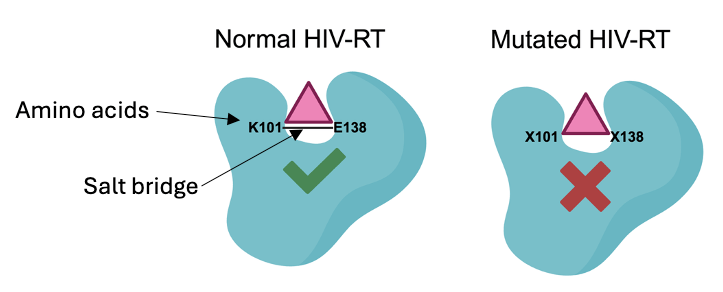
We designed compound 12126065 to bind HIV-RT even when mutations that change the shape of the protein are present in the active site. Proteins are made up of amino acids that are linked together. Some of the most common mutations in HIV-RT are found in two of these amino acids, lysine and glutamic acid. These amino acids are located at position 101 and 138 in the chain of amino acids that make up the HIV-RT protein, respectively (Figure 1). They are located on either side of the active site of the protein. In a normal HIV-RT protein, a salt bridge will form between the amino acids and this shortens the distance between them. When there is a mutation to lysine or glutamic acid, the salt bridge does not form. As a result, the shape of the active site changes and this makes it hard for existing medicines to bind. To avoid this problem, we intentionally designed compound 12126065 to be larger so that it would interact with more surface area within the active site. The larger compound could bind even when the salt bridge was absent because it could interact with more amino acids.
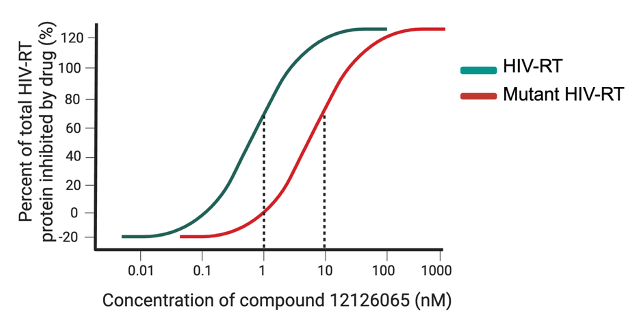
What My Science Looks Like: An important part of this research was to measure how much of compound 12126065 would be needed to stop the activity of HIV-RT. To do this, we used a cell line with live HIV viruses and measured how many viruses were left after treating the cells with the drug. Figure 2 shows the effects of compound 12126065 on both normal and mutant forms of HIV-RT, and how much compound is necessary to reduce the activity of the virus. We found that more compound 12126065 was needed to stop mutated HIV-RT than to stop the normal forms of HIV-RT. The mutated HIV-RT required 10 times as much compound to prevent activity. However, this dose is still low enough to be safe for treatment purposes.
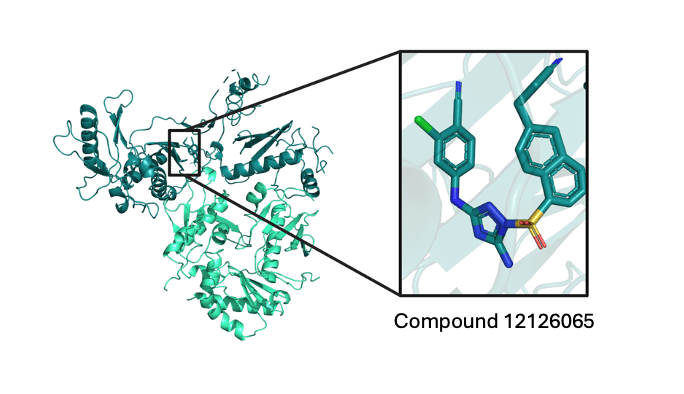
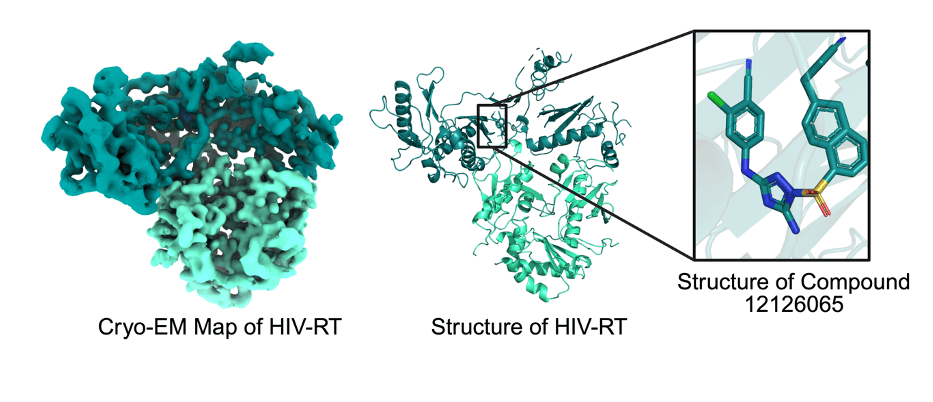
The next step of the research was to look at the structure of the HIV-RT protein with compound 12126065 bound to the active site. Being able to see the protein and compound together can help researchers understand why our compound was better at binding HIV than other FDA-approved drugs. To do this, I used cryogenic electron microscopy (cryo-EM), an imaging technique that is often used in structural biology to study protein structures. Cryo-EM involves freezing samples, taking advanced images, then using software to build a 3D image of a protein. The results showed that compound 12126065 binds to HIV-RT in the same active site as other NNRTIs and that it binds in a very similar direction. I was able to identify the shape of the compound when bound to the active site of the HIV-RT protein. I was also able to show how it interacts with the amino acids within the active site (Figure 3).
The Big Picture: Designing new medicines often involves a long and difficult process of elimination to figure out what stops a particular protein from working. The process goes much faster when researchers know more about how a protein interacts with a drug, and it can help us to design drugs that don’t negatively affect humans. Understanding how the structure of HIV-RT and compound 12126065 fit together can help scientists to improve the drug. Current medications for HIV patients focus on stopping many different proteins from this virus. However, this can cause a lot of unwanted side effects if these drugs bind to human proteins and disrupt the way the human body functions. Compound 12126065 was designed to target HIV-RT, a protein that is only found in the HIV virus. One of the benefits of compound 12126065 is that it should stop the virus but should not impact the function of other proteins in the human body. Compound 12126065 can help to improve the quality of life for patients with HIV, reduce their fatigue and other symptoms, and prevent more viruses from spreading in the body. While these results are promising, the work is still incomplete. The current research focused on testing the compound only in special cells designed to produce HIV viruses. The next step would be to see how well the drug performs in animals, before moving on to clinical trials with human patients with HIV.
Decoding the Language:
Acquired immunodeficiency syndrome (AIDS): The most advanced stage of the infection that is caused by the human immunodeficiency virus (HIV).
Active site: A region of a protein that can interact with small molecules, other proteins, and designed drug compounds
Amino Acid: The building block of proteins. Amino acids form a chain that make up a protein. Different amino acids will interact with each other such that they form a three-dimensional structure that causes the protein to fold.
Cell line: A population of cells grown in a laboratory that originated from a single original tissue sample and can be divided and transferred into new vessels over multiple generations.
Compound 12126065: A new type of non-nucleoside reverse transcriptase inhibitor (NNRTI) designed to stop HIV-RT. This compound was the focus of the research presented in this article.
Cryo-EM: An imaging technique used in structural biology to study very small objects such as proteins.
Dose response curve: a line graph that shows how a living system or biological target (often on the y-axis) reacts to different amounts (doses or concentrations) of a substance (often on
the x-axis)
HIV reverse transcriptase (HIV-RT): An enzyme found in retroviruses, such as HIV, that causes reverse transcription, which is when RNA is changed into DNA. In the human body, this occurs in the opposite direction; DNA is changed into RNA.
Human immunodeficiency virus (HIV): A virus that targets and infects human cells, replicates itself inside, and releases more viruses. If left untreated, HIV can cause acquired immunodeficiency syndrome (AIDS).
Mutation: A change in the nucleic acid sequence of DNA. Mutations can result in a change in the amino acid within a protein. When this happens, it can change the structure or function of a protein.
Non-nucleoside reverse transcriptase inhibitor (NNRTI): A class of medicines that are designed to inhibit the activity of a particular part of an HIV virus, the reverse transcriptase enzyme.
Salt bridge: A bond formed between two oppositely charged amino acids (one positive and one negative).
Structural biology: The study of proteins and how their structure dictates their function within the cell.
Structural biologist: A scientist that studies proteins and their structures.
Therapeutics: A branch of science that studies drug compounds that can be used as medicine.
X-ray crystallography: A structural biology technique that involves making crystallized solids out of proteins and using x-rays to determine where their amino acids are.
Learn More:
A research paper about the other structures of FDA-approved compounds in the HIV-RT active site.
A research paper describing the original chemistry behind compound 12126065.
An information page from the Centers of Disease Control containing information about HIV.
Synopsis edited by: Dr. Rosario Marroquín-Flores, Assistant Professor, James Madison University
Download this article here

