Featured Scientist: Nicholas C. Borgogna (he/him), Ph.D., University of Alabama at Birmingham, Department of Psychology

Birthplace: Logan, Utah
My Research: I research ways to improve the interventions that we use in a clinical setting to help people struggling with mental health.
Research Goals: I pretty much want to do the same type of research moving into the future. However, I am beginning to use meta-analysis for general research aims. I am also starting to incorporate longitudinal designs into specific research projects.
Career Goals: My goals are to move the field of psychology more towards humanistic models of mental illness.
Hobbies: Playing Poker and playing guitar (if Whysound is still a venue in Logan, I was in a band that was one of the first acts to ever play at Whysound in the summer of 2008).
Favorite Thing About Science: That there’s always more to the story.
Scientist Upbringing: The scientist part of my identity chose me rather than me choosing it. I had always anticipated being a clinician, but I ended up having a knack for writing and statistics that led to many opportunities in graduate school. I’ve since become very much a scientist and am clawing my way back to being a clinician.
My Team: I was the director of the project in question, but it was very much aided by the input from the co-authors. Everyone helped to write and revise parts of the paper. I sort of divided out little parts for specific folks to help with. For instance, Matt Kridel wrote the clinical implications section and Stephen Aita wrote the limitations section, in addition to helping with other parts of the manuscript.
Field of Study: Psychology
What is Psychology? Psychology is the study of mind and how it functions. People in the field of psychology are particularly interested in understanding human behavior.
Check Out My Original Article: “Anxiety and depression across gender and sexual minorities: Implications for transgender, gender nonconforming, pansexual, demisexual, asexual, queer, and questioning individuals.”

Citation: Borgogna, N. C., McDermott, R. C., Aita, S. L., & Kridel, M. M. (2019). Anxiety and depression across gender and sexual minorities: Implications for transgender, gender nonconforming, pansexual, demisexual, asexual, queer, and questioning individuals. Psychology of Sexual Orientation and Gender Diversity, 6(1), 54–63. https://doi.org/10.1037/sgd0000306.
Article written by undergraduate students enrolled in the social work program at Utah State University, with support from Catherine Gooch, undergraduate Kinesiology major at Texas Tech University.
Research At A Glance: Many people who identify as LGBTQ+ struggle with mental health. These experiences could be because LGBTQ+ persons are minorities in their communities. The minority stress model suggests that people who are oppressed in society experience more stress. The higher stress can lead to poor mental health. While these trends have been studied for a long time, there is less information about people with emerging identities and their experiences with mental health. Emerging identities are newer gender and sexual identities. These identities differ from some of the more recognized identities that have been used for longer, such as heterosexual or homosexual. This study looks at anxiety and depression among college students who identify as LGBTQ+. The authors compare the experiences of LGBTQ+ students with emerging identities to those with older identities (i.e., gay and lesbian), as well as to those outside of the LGBTQ+ community. To do this research, the authors used an online survey. They asked students questions about mental health and how they use mental health services. They found that students with emerging identities had more depression and anxiety than students outside of the LGBTQ+ community. They also had more anxiety and depression than students who identified as gay or lesbian. The authors also found that students who identified as both a gender minority (someone who has a gender identity that does not align with traditional male or female gender roles) and a sexual minority had poorer mental health than students who did not. The findings show that mental health professionals should be mindful of the influence of gender and sexuality on mental health.
Highlights: The Healthy Minds Study is a survey for college students that asks questions about mental health and how students use services to help manage their mental health. This study included data from the Healthy Minds Study on over 40,000 students. While there are many variables related to mental health included in the survey, this study focused on anxiety and depression. The authors used the responses from the survey to place students into two groups. The first group included students who identified as transgender and gender nonconforming (TGNC). A transgender person is someone who identifies with a gender that does not match their biological sex. Someone who is gender nonconforming is someone who does not conform to cultural expectations about how men and women are supposed to behave or dress. The second group included students who identified as lesbian/gay, bisexual, pansexual, demisexual, asexual, and queer. The second group was referred to as “sexual minorities”. Bisexual refers to someone who can experience romantic or sexual attraction to people from more than one gender. Pansexual refers to someone who can experience attraction to people of any gender. Demisexual refers to someone that needs an emotional connection with someone before they can feel attracted to them. People who identify as asexual experience little to no sexual attraction. Queer is a broad term that can refer to any identity that is not heterosexual or that conforms to traditional male or female gender roles.
The authors in this study wanted to understand the relationship between student identities and mental health. To do this, the authors used a statistical test called Multivariate Analysis of Variance (MANOVA). A MANOVA is used to look at the differences between groups on more than one variable. In this research, the authors used MANOVA to look at the differences in anxiety and depression between students who identified TGNC, as sexual minorities, and those who did not identify as LGBTQ+. The authors found that TGNC students had lower mental health than students who were not transgender or gender nonconforming (Figure 1). Specifically, TGNC students had higher depression and anxiety than non-TGNC students. They also found that sexual minorities had higher anxiety and depression than heterosexual students (Figure 2). This was particularly true for demisexual students. The results show that some sexual minorities struggle more with mental health than others. Lastly, the authors found that students who identified as both TGNC and as a sexual minority had lower mental health than those who did not (Figure 3).


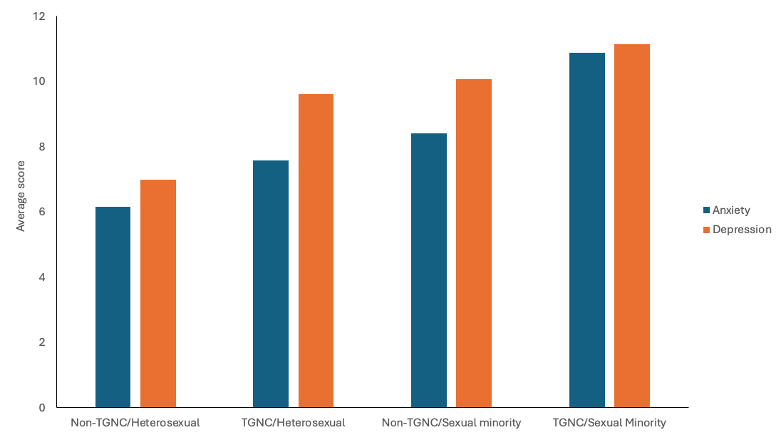
What My Science Looks Like: An important part of this study was how the authors measured mental health. The Healthy Minds Study used a survey called the PHQ-9 to measure depression in students (Figure 4). The survey includes nine questions that ask students how often they experience feelings like being tired, feeling like a failure, or thinking about hurting themselves. A similar survey called the GAD-7 was used to measure anxiety (Figure 4). This survey includes seven questions that ask students about how often they experience feelings like being worried, afraid, or having trouble relaxing. These two surveys are often used by mental health researchers to measure anxiety and depression. Mental health professionals can used information from these surveys to see if someone needs mental health services, and what type of help would be most useful for them.

The Big Picture: People who identify as LGBTQ+ are 4 times more likely to attempt suicide than their peers. This research is important because it helps shed light on mental health issues within the LGBTQ+ community. It shows that people with more than one gender or sexual identity are more likely to have anxiety and depression. This helps us understand who is most at risk. We need services that are informed and capable of working with people within the LGBTQ+ community. It is important to provide direct services to this group. As part of this research, the authors offer several suggestions for mental health professionals that can be used to help support LGBTQ+ students. First, mental health professionals can use gender-neutral language, such as using the word “partner” to refer to significant others. They can also include a section in their paperwork that allows people to write down which pronouns they would like other people to refer to them with. The authors also suggested that clinicians be aware of the experiences of LGBTQ+ persons when creating and directing services. Information from this research can help mental health professionals create prevention and intervention programs. It is also important for places like hospitals, universities, and corporations to have educational programs that can bring awareness to these issues. Each of these steps can help to better support mental health within the LGBTQ+ community.
Decoding The Language:
Anxiety: Anxiety refers to feeling tense, worried, and fearful.
Asexual: Someone who identifies as asexual has little or no sexual attraction to others.
Clinician: A clinician is a healthcare professional who works directly with patients.
Demisexual: Someone who identifies as demisexual is an individual who needs an emotional attachment to find another individual sexually attractive.
Depression: Depression refers to a consistent feeling of sadness and a loss of interest that can lead to disruptions in normal activities.
Generalized Anxiety Disorder-7 (GAD-7): The GAD-7 is a seven-question survey designed to measure symptoms of anxiety.
Gay: Someone who identifies as gay is a man who finds other men sexually attractive.
Gender minority: Gender minority is a term that is similar to sexual minority. It is a group whose gender identity differs from gender norms.
Gender nonconforming: Individuals who are gender nonconforming are those who not conform to cultural expectations about how men and women are supposed to behave or dress based on their gender.
Healthy Minds Study (HMS): The HMS is a web-based survey used by undergraduate and graduate college students.
Heterosexual: Someone who identifies as heterosexual is attracted to people of the opposite sex.
Humanistic model: The humanistic model is an approach that looks at an individual as unique and as a whole person.
Lesbian: Someone who identifies as a lesbian is a woman who finds other women to be sexually attractive.
LGBTQ+: LGBTQ+ is an acronym for lesbian, gay, bisexual, transgender, queer, and emerging identities.
Longitudinal design: Longitudinal design refers to research projects that take place over a long period of time.
Meta-analysis: A meta-analysis is an analysis of many different studies in a particular field. This is useful because it can provide an overview of trends in research and the current state of the field.
Minority Stress Model: The minority stress model states that sexual minorities experience added stressors because of their sexual orientation or gender identity.
Multivariate Analysis of Variance (MANOVA): A MANOVA is a statistical technique that determines the effects of independent variables on multiple continuous dependent variables.
Pansexual: Someone who identifies as pansexual can have emotional or sexual attraction to others regardless of gender or sex.
Patient Health Questionnaire-9 (PHQ-9): The PHQ-9 is a nine-question survey designed to measure symptoms of depression.
Queer: Someone that identifies as queer is someone outside of sexual/gender norms. It is a nonspecific term that can capture several types of gender and sexual identities.
Sexual minority: A sexual minority is a group of people whose sexual orientation differs from sexual norms.
Transgender and nonconforming (TGNC): TGNC is the term that the authors used to describe a group of people who identify as transgender (trans) men, trans women, or gender nonconforming.
Learn More:
An article from The Trevor Project with information about LGBTQ youth suicide. The article is from 2022.
An article from The Center organization that provides more information about LGBTQ+ identities.
An article from MD+ Calc about the Patient Health Questionaire-9, which measures depression.
An article from MD+ Calc about the Generalized Anxiety Disorder-7 survey, which measures anxiety.
A research article that examines the discrimination often faced by emerging identities and how discrimination is associated with depression and anxiety rates among emerging identities:
Puckett, J. A., Maroney, M. R., Wadsworth, L. P., Mustanski, B., & Newcomb, M. E. (2019). Coping with discrimination: The insidious effects of gender minority stigma on depression and anxiety in transgender individuals. Journal of Clinical Psychology, 76(1), 176–194.
A research article that examines depression and anxiety rates in gender minorities compared to cisgender persons. Using data from Growing Up Today Study. Reisner, S. L., Katz-Wise, S. L., Gordon, A. R., Corliss, H. L., & Austin, S. B. (2016). Social epidemiology of depression and anxiety by gender identity. Journal of Adolescent Health, 59(2), 203–208.
Synopsis edited by Rosario Marroquín-Flores (she/her), Ph.D., James Madison University.
Download this article here
 PubNavigator