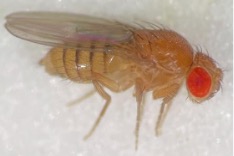
Featured Scientist: Dr. Sabrina Mostoufi (she/her), University of Oregon, Department of Biology.

Hometown: Burney, California
My Research: My research is focused on the fruit fly, Drosophila melanogaster, and the bacterium, Wolbachia pipientis. Flies infected with Wolbachia have increased recombination rate, but we don’t know why! My doctoral work has been focused on trying to figure out how and why Wolbachia increases recombination rate in flies.
Research Goals: In the future, I’d like to continue working with fruit flies to answer questions about what affects recombination rate and how Wolbachia affects flies.
Career Goals: My goal is to become a college biology teacher. I’d love to work at a smaller college where I can combine teaching and some research projects with undergraduate students.
Hobbies: I enjoy skiing, gardening, crocheting, playing video games, and playing board games.
Favorite Thing About Science: I love the challenge and puzzle-solving in science, especially in genetics. I also do a lot of coding in my work, which has ups and downs, but finally getting a difficult piece of code to work is an awesome feeling.
Scientist Upbringing: When I was growing up, I thought about several career paths: dentist, author, archaeologist, astronaut, and more. I always loved my math and science classes. I started college as a biology major because I was interested in going to veterinary school. In my first term of college, I fell in love with genetics during my intro biology class and quickly decided that I wanted to learn more in graduate school. The rest is history!
My Team: My advisor, Dr. Nadia Singh, and I are the two authors on this paper. I carried out all the experimental work for this project. I crossed and counted flies, extracted DNA for qPCR, and made the different food treatments. Nadia and I discussed the data analysis together and the best way to present the results for the paper. Nadia also provided a lot of guidance through the peer-review process, since this was my first published paper.
Organism or Area of Study: I study the fruit fly, Drosophila melanogaster, and the bacteria, Wolbachia pipientis.

Field of Study: Evolutionary genetics
What is Evolutionary genetics? Evolutionary genetics is a field of biology. People in this field study how genes change over time. They also study how these changes help species to evolve.
Check Out mMy Original Paper: “Diet-induced changes in titer support a discrete response of Wolbachia-associated plastic recombination in Drosophila melanogaster.“

Citation: Mostoufi, S. L., & Singh, N. D. (2022). Diet-induced changes in titer support a discrete response of Wolbachia-associated plastic recombination in Drosophila melanogaster. G3 Genes|Genomes|Genetics, 12(1), jkab375. https://doi.org/10.1093/g3journal/jkab375
Article written by Isabel Billings (she/her, Senior, Psychological Sciences), Carissa Foreman (She/her, Senior, Biology), Ga Yeon “Karen” Kim (She/her, Senior, Biology & General Studies), Braden Kirk (He/him Senior, Biology), Desiree Lopez (She/her, Junior, Biology), Anakin Niño (He/Him Junior, Biology), Catherine Gooch (She/her, Senior, Kinesiology) Texas Tech University.
Research At A Glance: The fruit fly is an insect that shares many genes with humans and is often used to better understand our DNA. In this study, the authors used the fruit fly to study a process called recombination. Recombination takes place when genetic information is swapped between pairs of chromosomes. Chromosomes are DNA structures inside most cells of every living organism. They are made up of proteins and DNA. When the body makes more cells, the chromosomes will align with each other and trade pieces of genetic material. This creates new combinations of traits. Over time, this can make a population more diverse, which can help species adapt to changing environments. In this study, the authors were curious if recombination is different in fruit flies when they are infected with Wolbachia. Wolbachia is a type of bacteria that frequently infects insects, like the fruit fly. The authors looked at how Wolbachia influences recombination. They also looked to see if recombination varies by the amount of Wolbachia in the fruit fly. To do this, the authors studied two groups of fruit flies, one group infected with Wolbachia and one healthy group. In each group, a third of the flies were fed with a sugar-enriched diet, a third was fed with a yeast-enriched diet, and the remaining flies were fed a normal diet. The authors selected these diets because they had previously been shown to affect the amount of Wolbachia in the flies. The authors found that Wolbachia infection does affect recombination in the fruit fly. However, they did not find an effect of diet. This research is important to better understand how infection with Wolbachia impacts genetic recombination.
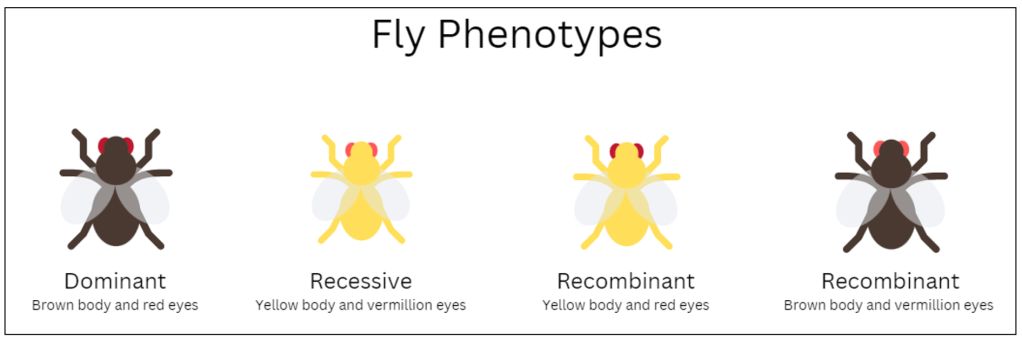
Highlights: One important part of this research was how the authors measured recombination. In genetics, a phenotype is a trait that is physically visible on an organism, such as hair color. Traits can either be dominant or recessive. A dominant gene will produce a trait that overrides the effect of another gene. For example, brown hair is dominant over red hair. So, if two parents have a child, where one parent has brown hair and the other has red hair, then their children will have brown hair. A recessive gene will only produce a trait when there is no dominant gene present. So, if two parents with red hair have children, then those children will have red hair. This is because there are no other dominant genes interfering with the gene that leads to red hair. In this paper, recombination was measured by looking at the color of the flies. The authors mated flies with dominant and recessive genes over three generations. Flies with the recessive phenotype had a yellow body color and vermillion eye color. Flies with the dominant phenotype had a brown body color and red eyes. The authors knew that a fly was recombinant when it showed a cross between the colors that came from dominant and the recessive genes. This could be either a yellow body with red eyes, or a brown body with vermillion eyes (Figure 1).
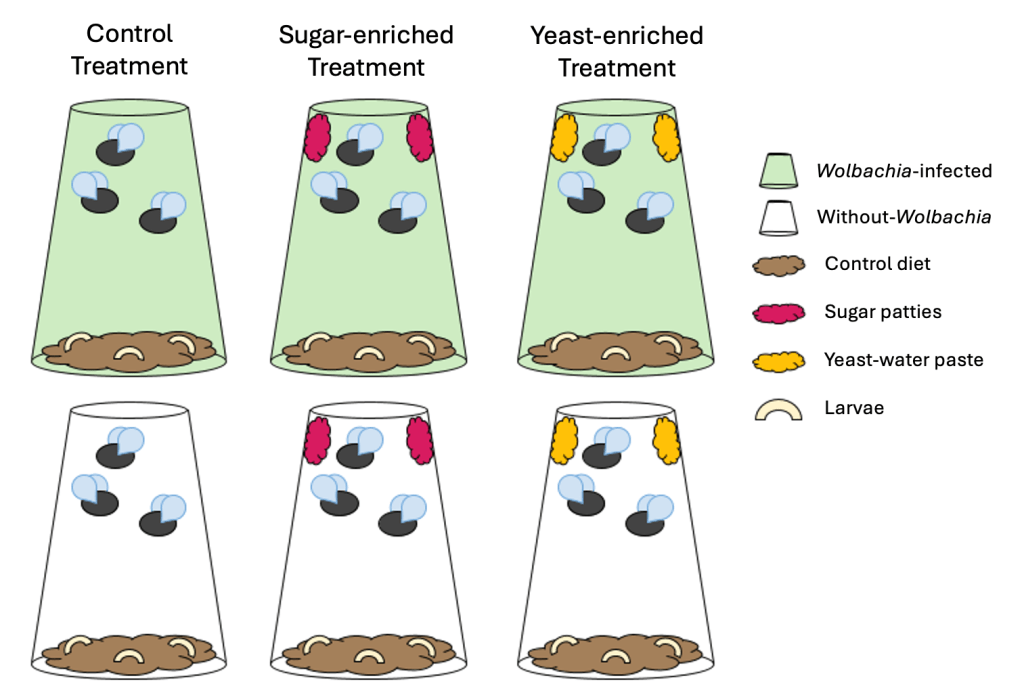
What My Science Looks Like: Another important part of this research were the diets that the authors fed the flies (Figure 2). The authors split the flies into three groups, each fed a different diet. These were a control diet, a sugar-enriched diet, and a yeast-enriched diet. The control diet consisted of cornmeal and molasses, which is common in research with flies. Flies eating the sugar-enriched diet still had access to the control food at the bottom of the vial but were also given 40% sugar patties at the top of the vial. The authors put the sugar patty on top so that the adult flies would eat the sugar-enriched diet while their larvae could only eat the control diet. This was important because the authors found that the sugar-enriched diet led to higher mortality and slower development in the larvae of both Wolbachia-infected and non-infected flies. Similarly, flies eating the yeast-enriched diet were given a paste mixed of yeast and water at the top of the vial, with the control food at the bottom. The authors chose this diet because previous research has shown that yeast will have an impact on the concentration of Wolbachia in the flies.
When the experiment was complete, the authors used a logistic regression model to analyze the data. A logistic regression model is a statistical tool used to show how likely it is that an event will happen. The authors wanted to figure out if the diet, the infection with Wolbachia, or both, would lead to recombination in flies. The authors found that infection with Wolbachia increased recombination, but diet did not. Flies that ate food with Wolbachia had more offspring with the recombinant phenotype than those that did not (Figure 3).

The Big Picture: Recombination is an important part of genetic diversity. When populations have more genetic diversity, they are better at responding to changing environments. This can help animals to survive changing conditions, like a warming climate. This paper shows how the DNA of the fruit fly is affected when they are infected with Wolbachia. Wolbachia is very common in fruit flies, infecting as many as 30% of the flies available for scientists. However, it is still not clear why Wolbachia affects recombination. Future advances in science could help to explain this. For example, if researchers could modify one trait of the Wolbachia at a time, this would allow them to figure out which part of the bacteria affects recombination in the flies. The fruit fly also shares many genes with people. This research is important because it could also help us understand recombination in humans.
Decoding the Language:
Boxplot: A boxplot is a figure that displays a summary of a set of data. The lowest place on the bottom line shows the lowest number, the bottom of the box shows the first quartile (25% of the data is under this line in the box), the central line in the box shows the median, the top of the box shows the third quartile (75% of the data is under this line in the box), and the highest place on the top line shows the highest number.
Chromosome: A chromosome is a structure found inside the nucleus of a cell, where all the DNA is stored. A chromosome is made up of DNA that is tightly wrapped around proteins. The DNA contains the information for all the genes in the body.
Coding: Coding is the process of writing instructions that a computer can understand. The computer can then use these instructions to create applications, websites, algorithms, or other technologies. Many scientists within this field will use computing programs, such as RStudio or Python, to organize and analyze their data.
Dominant: Dominant refers to a form of a gene that is more likely to be expressed than other versions of the gene. In the context of this study, the dominant gene was the one that led to flies with brown bodies.
Genes: Genes are like recipes that are made up of DNA. They contain instructions for making specific proteins. When these proteins are produced, they can take action within the body and affect things like physical traits.
Genetics: Genetics refers to the scientific study of genes and heredity—of how certain qualities or traits are passed from parents to offspring because of changes in the DNA sequence.
Genetic diversity: Genetic diversity refers to the many different types of genes that can exist within a species.
Larvae: Larvae are the undeveloped form of insects, at the earliest stages of development. Larvae hatch from eggs and will feed until they grow and develop wings.
Logistic regression model: A logistic regression model is a statistical technique that can be used to estimate the likelihood that something will take place. In this context of this research, the authors used logistic regression to see how likely it was that recombination in flies was influenced by infection with Wolbachia and by the diet the flies were fed.
Peer-review process: The peer-review process is when a research article is reviewed by experts in the field before the research gets published in a scientific journal. Usually, 2-3 reviewers are invited to review the article. These reviewers will make a recommendation about whether the article should be accepted and published in the journal or if it should be rejected.
Phenotype: Phenotype refers to an organism’s observable traits, such as its physical appearance or behavior. In the context of this research, the color of the fly was the phenotype that the authors were looking for to determine if recombination had taken place.
Recombination: Recombination is the process where genetic information is exchanged between two different DNA molecules. This results in new combinations of genes. Recombination rate can be defined as the average number of crosses among cells.
Recessive: Recessive is a term used to describe a gene or allele that is only expressed when paired with another recessive allele. In the context of this study, the recessive gene was the one that led to yellow or vermillion flies.
Vermillion: Vermillion refers to a brilliant red pigment. Wolbachia:Wolbachia is the name of a bacteria that infects insects. It is the world’s most common reproductive parasite.
Learn More:
A YouTube video produced by Biology by Sayan giving an overview of Back Crosses and Test Crosses, with examples of each.
A YouTube video produced by GLA Mosquito that introduces flies and describes how Wolbachia is used in modern science.
A YouTube video produced by Science News that provides an easy-to-dissect visualization of DNA recombination, using Lego toys and simple vocabulary.
Synopsis edited by: Dr. Rosario Marroquin-Flores (She/her), Postdoctoral Scholar, Texas Tech University.
Download this article here
About the Authors
Isabel Billings (She/her, Senior, Psychological Sciences)

I’m a first-generation college student majoring in psychological sciences with an interest in cortisol stress levels and their relationship with self-injury. With a passion for science, I continue to conduct research that benefits the environment and the people/things in it!
Carissa Foreman (She/her, Senior, Biology)

I am a 4th year student at Texas Tech University majoring in biology with a minor in health professions. I am passionate about science as well as utilizing my knowledge in the topic to help others. My goal in the future is to become a field ecologist and study the relationship between the environment and our communities!
Ga Yeon “Karen” Kim (She/her, Senior, Biology & General Studies)

I’m a dual-degree, First-Generation, Honors student, majoring in Biology and General Studies, with concentrations in Chemistry, Psychology, and Spanish. I’m interested in becoming a Physician Assistant in the future and building meaningful connections with patients!
Braden Kirk (He/him, Senior, Biology)

I am part of the Texas Tech College of Arts and Sciences department as a Biology major, with a Chemistry minor. I am an aspiring dental student, hoping to attend dental school in the 2024 academic year. I plan on using my gap year to further my exposure to the dental field, with full commitments to volunteering and collaborating with various organizations and dental offices in Lubbock, Texas.
Desiree Lopez (she/her, Junior, Biology)

I am a First-Generation student at Texas Tech University majoring in Biology with a minor in Chemistry and Business. I am passionate about keeping our planet healthy as well as individuals I encounter. With this motivation I participate in polymer research working to better the end-of-life stage of plastics. I aspire to become a Dentist, providing patients with much needed care and confidence.
Anakin Niño (He/him, Junior, Biology)

I am a First-Generation second year biology student at Texas Tech. Currently, I work with the Texas Tech Health Science Rural & Community Health Institute in the marketing, social media, and website department. In the near future, I aspire to become a physician assistant in either dermatology or psychiatry.
Catherine Gooch (She/her, Senior, Kinesiology)

I’m a senior Kinesiology major at Texas Tech University, with minors in Cognitive Science and Philosophy. I currently do undergraduate research in the Perception, Cognition, and Action Lab here. After graduating, I hope to continue doing research in graduate school. In my free time, I enjoy reading, playing chess, and spending time in nature.
 PubNavigator