Featured Scientist: James Huỳnh, he/him, MA, MPH; PhD Student in Department of Community Health Sciences at UCLA Fielding School of Public Health

Hometown: Fontana, CA
My Research: My research is about inequality in society and how that impacts people’s health. I work with communities of color, immigrants, refugees, Indigenous people, and LGBTQ+ people. My work focuses on combining intersectionality theory and queer of color critique. I use mixed methods to apply these theories to public health. I focus on queer Asian/American communities, the social and political definition of family and kinship, and well-being.
Career Goals: I plan to be a professor who does community-engaged research. I wantto help queer communities of color address the public health issues that are important to them.
Hobbies: Reading fantasy novels and tending to my cranky but loveable Shiba.
Field of Study: Public Health, Gender Studies, Asian American Studies
What is Public Health and Gender Studies? Public health research focuses on ways to improve and protect the health of people and their communities. Gender studies research focuses on the relationship between gender, politics, culture, and power. It explores how gender affects people’s identities and behaviors. This field includes understanding the relationship between gender and politics. These two fields share a focus: promoting the health of people from all genders, especially those who face discrimination.
Check Out My Original Paper: “Family Is the Beginning but Not the End”: Intergenerational LGBTQ Chosen Family, Social Support, and Health in a Vietnamese American Community Organization.

Citation: Huynh, J. (2023). “Family Is the Beginning but Not the End”: Intergenerational LGBTQ Chosen Family, Social Support, and Health in a Vietnamese American Community Organization. Journal of Homosexuality, 1-23.
Article written by undergraduate students enrolled in the social work program at Utah State University.
Research At A Glance: Many members of the LGBTQ+ community experience discrimination. This study focuses on the experiences of the author and the community organization that he works with. The author talks about how being a member of the Viet Rainbow of Orange County (VROC) organization. The VROC community was started by five LGBTQ+ Vietnamese Americans who were not allowed to march in the Tết parade because they identified as LGBTQ+. Those five people went on to form VROC, hoping to make an unbiased, safe, and unified Vietnamese group that treats every member fairly. VROC provides a place where people feel a sense of belonging, have support from others, and have safety from the violence that LGBTQ+ people experience. In this study, the author used semi-structured interviews and participant observation to gather information about how the VROC organization has impacted its members. The author focused on two research questions: 1) How do VROC members create and think about family and kinship? 2) How does participation in VROC impact perceptions of sức khỏe (“health”)? The author found three main themes in the interviews: queering family and kinship, Vietnamese motherhood and the social reproduction of the family, and the social ties and community connectedness as relational dimension of health. Asking about sức khỏe is commonly used as a greeting. It normalizes the practice of checking in on the health and well-being of others. This can be a starting point for members and help them form social connections with each other. The findings of the study suggest that the VROC community offers a safe place for people to be vulnerable, allowing negative energy to be released. This provides a space to build strong relationships between members and their chosen family.
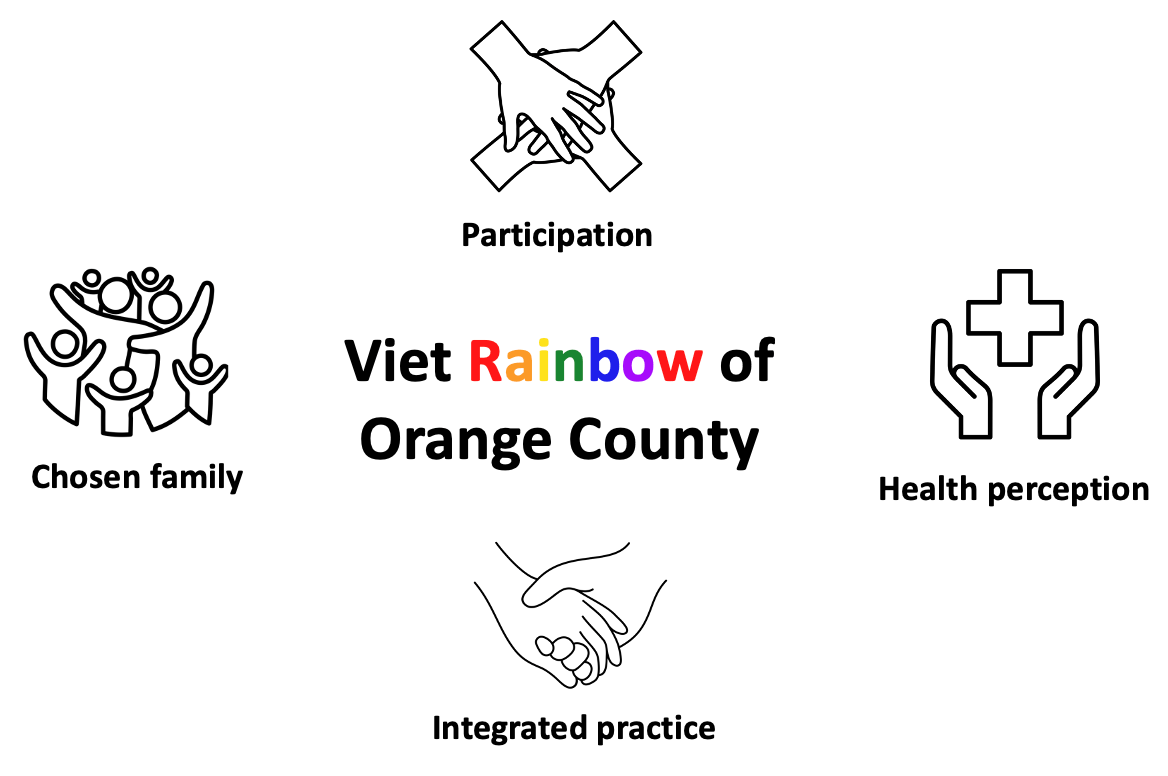
Highlights: In this study, the author used participant observation. The author participated in VROC organizational meetings over a six-month period and took notes about what happened. The author wanted to see how members navigated their personal identities, LGBTQ+ activism, and how this affected their views on health. Fifteen members of the organization were interviewed. The author wanted to gauge how people in the LGBTQ+ community were doing and how they felt within the VROC community. Purposive sampling was used to recruit people to the study. The goal was to recruit people who could provide different perspectives about being a part of VROC. The people participating included members of the LGBTQ+ community, women who provided motherly love to everyone, and people from the Vietnamese American Community. The interview questions were based on four different domains: Identity, Family, LGBTQ+ Activism, and Health (Figure 1).
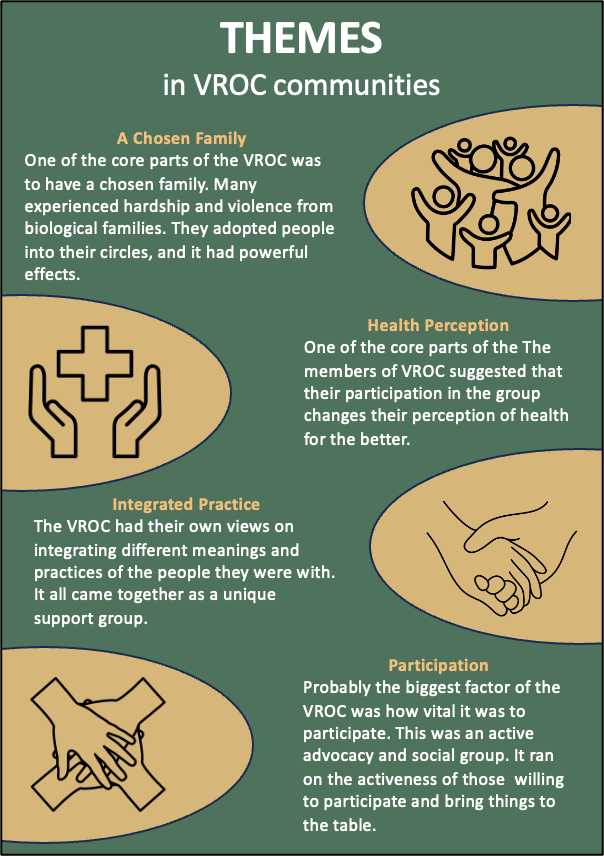
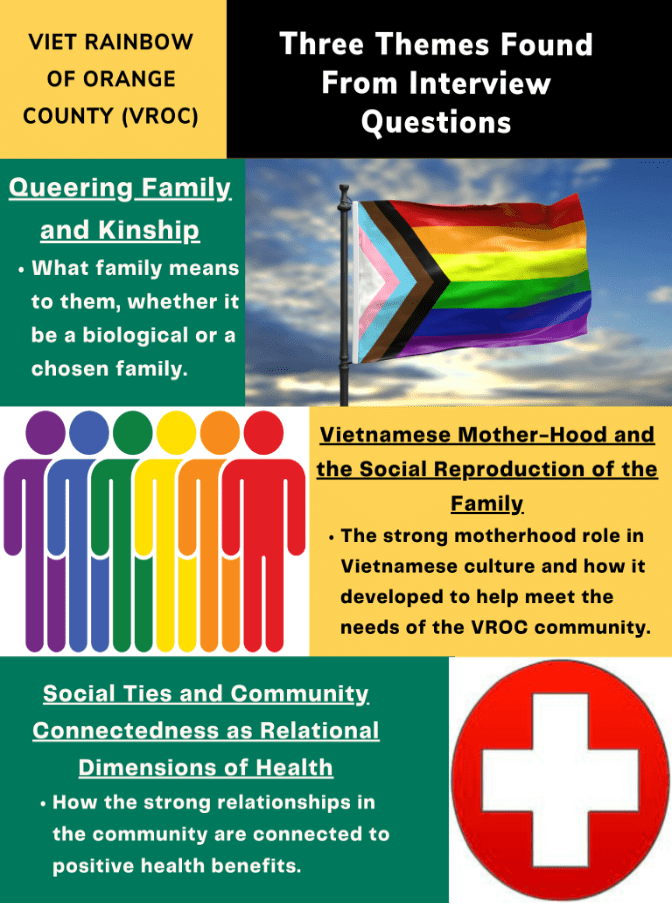
What My Science Looks Like: As part of data collection, the author took field notes each day. The author then used a technique called narrative analysis to find themes in the data. Narrative analysis can be used to understand how people create a story based on their own experiences. The author found three themes: queering family and kinship, Vietnamese motherhood and the social reproduction of family social ties and community connectedness as relational dimensions of health (Figure 2).
This research draws upon feminist and queer of color theoretical frameworks. The feminist framework focuses on fighting oppression and inequality based on gender. The queer of color framework focuses on how power affects people. It focuses specifically on race, class, gender, and sexuality. An important finding in this study was that love and support in the LGBTQ+ community had a positive impact on physical health and wellbeing. The author also focused on how members of the VROC community often choose their families when their biological family was not supportive. Sometimes our biological family doesn’t give us the support and love we need, or sometimes they are not nearby. These VROC members took individuals that were not biologically related to them and viewed them as family. These people were able to fill the gaps that their biological family could not. The VROC community had strong community circles and showed each other support and appreciation. These healthy relationships were critical to being healthy overall.
The Big Picture: People in the LGBTQ+ community have experiences that can affect their perception of family and health. Chosen family is very important to many members of the LGBTQ+ community because they provide a source of social support. When people are rejected by their families, they can feel isolated. This is why chosen family is so important. In chosen families, people can pick like-minded people to spend time with. People might pick a chosen family when they have been alienated from their original community or want to find a more accepting environment. Chosen family can offer social resources, a sense of connection, and an opportunity to heal from trauma. Similar relationships are found among immigrant communities. VROC is an organization that works with LGBTQ+ Vietnamese Americans, helping them fight for their rights and giving them a safe space to be. This research is important because it can help us understand more about how non-traditional families work. If we know more about how sexuality and race affect people, their perceptions of family, and health, then we can find better resources to help them.
Decoding the Language:
Chosen Family: Chosen family refers to the people who have intentionally chosen to love and support each other, regardless of being blood relatives or related by marriage. The emphasis here is that people can choose anyone they want to be part of their family unit.
Community-Engaged Research: Community-engaged research is a type of research that involves working collaboratively with different groups of people in the community. Community can be determined by geographical location or common interests. In the context of this study, the VROC organization was engaged in the research process.
Discrimination: Discrimination refers to the unequal treatment of a group of people, especially related to their gender, race, sexuality, or age. People in these groups can be treated much worse than others. Discrimination can be verbal, physical, or legal.
Field notes: Field notes are a type of record taken by the researcher during the research process. These notes are based on events, conversations, and behaviors observed in the field.
Intersectionality theory: Intersectionality theory is the concept that different systems of oppression such as racism, homophobia, and sexism intersect. This creates unique dynamics or challenges in an individual’s life especially for those whose sexuality, gender, and race exist outside of society’s norms. In this study, the intersection of homophobia in Asian/American communities and racism in LGBTQ+ communities is examined.
LGBTQ+: The LGBTQ+ community is made up of various romantic and/or sexual orientations and gender identities. LGBTQ+ stands for lesbian, gay, bisexual, transgender, queer, and the + includes all other gender identities/sexualities within the community.
Mixed methods: Mixed methods refers to a type of research that involves the use of both qualitative (personal experience) and quantitative (statistical) data.
Narrative analysis: Narrative analysis is a form of qualitative research where the participants build a story based on their own experiences and the researcher interprets that story. To do this, the researcher will often collect stories from participants and then look for common themes that show up in these stories.
Participant observation: Participant observation is a data-collection method in research that involves the researcher actively participating in activities with the population they are conducting their research in so that they can better understand the internal structure of that population.
Purposive sampling: Purposeful sampling is a sampling technique used in this study that allows researchers to recruit people who hold certain qualities or statuses to gain in-depth and detailed information about the topic of interest.
Queer of Color Critique: The queer of color critique is an intersectional framework that examines how power dynamics caused by race, class, gender expression, and sexuality affect the experiences of individuals or groups that hold one or more of these identities.
Semi-Structured Interview: A semi-structured interview is a data collection method in research that uses open-ended questions to guide an interview and probe for responses that are useful to the study at hand.
Sức khỏe: Sức khỏe is a Vietnamese word that combined Sức (force/ strength) and khỏe (strong/ healthy). It includes physical health, mental and emotional health, and spiritual health.
Tết parade: Tết parade is an event on lunar new year organized by the Vietnamese American Federation of Southern California.
Theoretical Frameworks: A theoretic framework is a way to outline concepts, definitions, and existing theories about the research under study.
Viet Rainbow of Orange County (VROC): VROC is a community-based organization in Orange County, California that values equity, healing, joy, and social justice. They build community and strive to create a world where everyone has the resources to thrive with dignity. They primarily work with LGBTQ+ Vietnamese Americans through education, research, and advocacy.
Learn More:
A link to the Viet Rainbow of Orange County (VROC) website.
An article from the New York Times about chosen family in LGBTQ+ communities.
An article from Voice of OC that describes the experiences of one Vietnamese American who came out to their family.
A research paper that examines lesbian parents’ unique perceptions on and experiences with raising children in non-traditional families. Specifically, the article discusses the most challenging and the best experiences of lesbian parents over a 25-year timespan:
Gartrell, N., Rothblum, E. D., Koh, A. S., van Beusekom, G., & Bos, H. (2019). “We Were Among the First Non-traditional Families”: Thematic Perceptions of Lesbian Parenting After 25 Years. Frontiers in Psychology, 10, 2414.
Synopsis edited by Dr. Rosario Marroquín-Flores, Texas Tech University, Department Biological Sciences and Dr. Jayme Walters, Utah State University, Department of Social Work.
Download this article here
Please take a survey to share your thoughts about the article!
 PubNavigator