
Featured Scientist: Lela Rankin, Ph.D., Arizona State University, School of Social Work

Birthplace: Currently living in Tucson, AZ but grew up in Nova Scotia, Canada
My Research: Dr. Rankin’s scholarship focuses on helping families using an attachment framework. The attachment framework is based on a psychological concept that describes how people develop strong emotional connections with their caregivers, especially when they’re very young. These connections can affect how we feel about ourselves and how we interact with others as we grow older. Dr. Rankin was one of the first people to research infant carrying (i.e., babywearing) and has found health and mental health benefits for mothers and infants.
Research Goals: I would like to understand the mechanisms around babywearing. Why (and how) is it helpful for parents and children?
Career Goals: I would like to travel and study parenting and babywearing customs across cultures.
Hobbies: I like to read, listen to music, hike, spend time with my family, and travel.
Favorite Thing About Science: The ability to learn something that hasn’t been discovered before.
Scientist Upbringing: At first, I thought I wanted to be a therapist when I started my undergraduate degree, but soon fell in love with research. It was exciting to look at the data and be able to understand how it related to my research question. All the steps in research are enjoyable for me like writing, finding previous research studies, creating a hypothesis, and interpreting the findings.
My Team: Working in teams makes research fun and more efficient. I am the lead investigator on this project and oversaw all aspects of the manuscript development.
Organism of Study: Understanding the benefits of babywearing, particularly for vulnerable parents such as mothers with substance use disorders.

What is Social Work?: Social work is a social science that focuses on helping others work through and prevent problems in their daily lives.
Check Out My Original Paper: “Unpacking Perinatal Experiences with Opioid Use Disorder: Relapse Risk Implications”
Citation: Rankin, L., Mendoza, N. S., & Grisham, L. (2022). Unpacking Perinatal Experiences with Opioid Use Disorder: Relapse Risk Implications. Clinical Social Work Journal, 1-12.
Article Written by Emily Hanover(She/They), a Junior at Utah State University, Alexis Callor(She/Her), a Junior at Utah State University, Maya Harrell(She/Her), a Junior at Utah State University, Skye Jensen(She/Her), a Junior at Utah State University, and Kejah Bascon (She/Her) an M.S. student at Carleton University.
Research At A Glance: Postpartum, the period after having a baby, is a difficult time for many mothers, but mothers with a history of substance use often face a higher level of stress. The purpose of this research is to understand the factors that cause higher levels of stress. The postpartum phase is often forgotten about, especially in scientific research, yet it is a vital time in a new mother’s life. It is important to understand a mother’s experience in the months after birth to find ways to better support these new moms. For this study, a group of mothers with a history of substance use were interviewed three times after the birth of their child. These interviews gathered information about mental and physical health. The mothers were also asked if they had urges to use substances again. The authors found several themes that affected a mother’s desire to use substances. The data from this study could be used to help doctors, social workers, and other professionals working directly with postpartum mothers to better understand the experiences they are facing. This information is important so that professionals can provide helpful and stigma-free care.
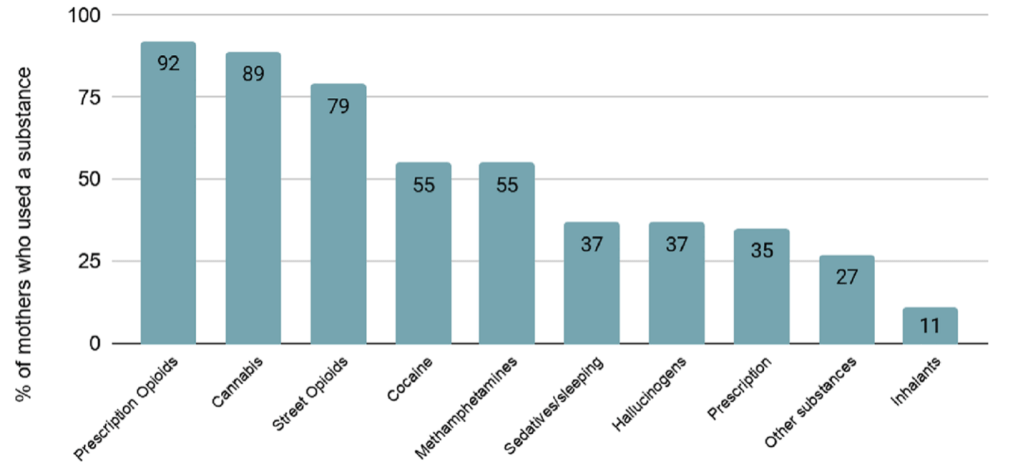
Highlights: Forty-two biological mothers with a history of substance use were recruited as participants for this research. The participants were interviewed three times throughout the study: Once at the birth of their child; once at 3 months postpartum; and once again at 6 months postpartum. These interviews were aimed at understanding the mother’s experience with urges to use substances and factors that helped them not to act on those urges. The participants were also asked to fill out a survey that indicated how often they had urges to use specific substances. Figure 1 shows the types of substances the mothers reported using before the birth of their child.
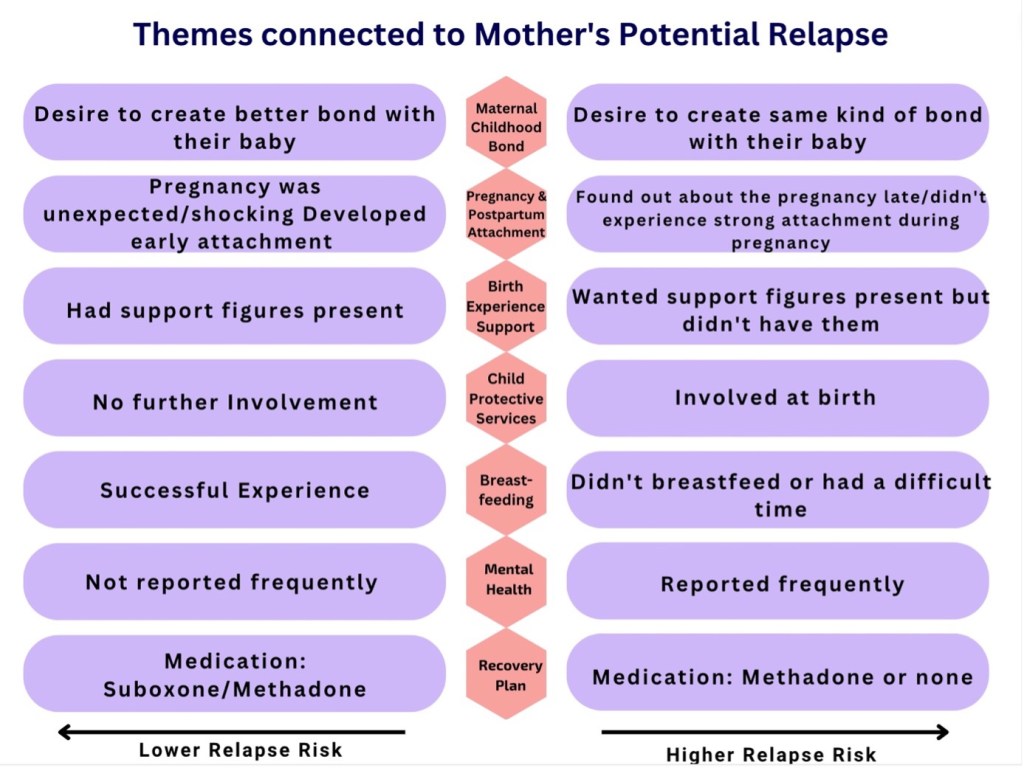
To analyze the data, the mothers were assigned to one of three categories based on the urges they had throughout the study. Mothers who did not have any urges during the study were classified as mothers with no urges (MNU). The mothers who didn’t have any initial urges, but did have urges later in the study, were classified as mothers with no initial urges (MNIU). The mothers who had urges to use were classified as mothers with urges (MU). Out of the 42 participants, 24% were MNUs, 14% were MNIUs, and 62% were MUs. These categories helped during the data analysis process because they helped the authors find themes related to relapse. In this study, the authors found seven themes related to a mother’s potential to relapse (Figure 2).
What My Science Looks Like As mentioned before, the mothers were interviewed three times throughout the study. In these interviews, the mothers were asked a series of questions aimed at understanding their experiences before, during, and after the birth of their child. Figure 3 provides examples of questions that were asked.

The Big Picture: After a mother gives birth, she may face many challenges like postpartum depression, postpartum psychosis, anxiety, and problems with physical health. Substance use disorder and relapse are also serious issues for postpartum parents. This research looks at mothers who have a history of substance use disorder and how it impacts their ability to create good attachments with their children, as well as other experiences after the birth of the child. The year after birth is the time that mothers are most likely to relapse. This study looks at the stigma surrounding relapse for mothers after the birth of the child. Because of the fear of judgment that these mothers may have, they may not know how to ask for help or know how to address their concerns. This information is crucial because it can help professionals approach situations without judgment. This research can help professionals understand why new mothers may relapse and how to address it. These findings can help social workers and other healthcare professionals treat mothers who are at risk for relapse during the postpartum period.
Decoding the Language:
Anxiety: Anxiety is a feeling of excessive worry, fear, or nervousness about something, often in the future, that can make a person feel uneasy or stressed. In new mothers, anxiety might mean constantly worrying about the baby’s safety, health, or whether they’re doing a good job as a parent. For example, a new mom might feel anxious when her baby has a fever, thinking about all the worst-case scenarios, even though the baby’s fever is likely due to a common illness that will pass.
Attachment framework: The attachment theory was developed by a British psychologist named John Bowlby. The theory describes three main attachment styles: secure attachment, anxious attachment, and avoidant attachment. People who form secure attachment feel comfortable getting close to others and trusting their relationships. People who form anxious attachment can worry a lot about their relationships and need frequent reassurance. People who form avoidant attachment may avoid getting too emotionally close to people and prefer to keep their distance.
Babywearing: Babywearing is a practice where parents or caregivers use special carriers or wraps to carry their babies close to their bodies. This allows for hands-free baby transport and promotes bonding between the caregiver and the baby. It can be convenient for both the adult and the baby, as it allows the baby to feel secure and comforted while the caregiver can go about daily activities.
Mothers with no initial urges (MNIU): Mothers in this study who initially did not have the urge to relapse and go back to using a substance, but then developed those urges later, were called MNIUs.
Mothers with no urges (MNU): When an individual stops using a substance, they may start to have withdrawals and they may have urges to start using the substance again. Mothers in this study who did not have the urge to use any substance were called MNUs. These mothers were at a lower risk of relapse.
Mothers with urges (MU): MUs were the mothers in this study who had the urge to relapse and go back to using a substance.
Postpartum: The period following the birth of a child. The postpartum stage is different for everyone, and mothers are at higher risk of experiencing mental health issues.
Postpartum depression: A medical condition that many women get after having a baby. Symptoms consist of strong feelings of sadness, anxiety (worry) and tiredness that last for a long time after giving birth. These feelings can make it hard for you to take care of yourself and your baby.
Postpartum psychosis: A condition where new mothers can experience extreme confusion, lose their connection with reality, become very paranoid, have strange beliefs, their thoughts become disorganized, and they might see or hear things that aren’t there.
Relapse: After an individual quits using a substance then returns to using the substance. Individuals often relapse when they are going through stressful periods.
Stigma: Common unfair or negative beliefs that some groups of people carry about certain ideas.
Substance use: Substance use means using things like alcohol, tobacco, drugs, or other stuff that you can eat, drink, smoke, or inject into your body. Sometimes, people use these things too much and can’t stop, which can cause a lot of problems for their health and life.
Substance Use Disorder (SUD): An SUD is a mental disorder that affects how an individual’s brain works which can lead to using substances. Substance use disorders include all types of substances that are being misused.
Learn More:
A YouTube video produced by Atmoi that describes the Attachment Framework.
A report from The White House discusses how many mothers who may be at risk for relapsing are having a hard time finding resources and help. Many of these women are having their children placed in foster care.
A research article that takes a look at how mental health and illness plays a part in Mother at risk for relapsing, and how that may look in the mother-infant bond:
Cataldo I, Azhari A, Coppola A, Bornstein MH and Esposito G (2019) The Influences of Drug Abuse on Mother-Infant Interaction Through the Lens of the Biopsychosocial Model of Health and Illness: A Review. Front. Public Health, 7, 45.
A research article that discusses many of the stress factors that can be contributors to mothers relapsing, and how that is affected by the bond with their newborn, as well as how it affects their bond:
Biaggi, A., Hazelgrove, K., Waites, F., Fuste, M., Conroy, S., Howard, L. M., Mehta, M. A., Miele, M., Seneviratne, G., Pawlby, S., Pariante, C. M., & Dazzan, P. (2021). Maternal perceived bonding towards the infant and parenting stress in women at risk of postpartum psychosis with and without a postpartum relapse. Journal of Affective Disorders, 294, 210–219.
Synopsis edited by Dr. Rosario Marroquín-Flores, Texas Tech University, Department Biological Sciences and Dr. Jayme Walters, Utah State University, Department of Social Work.
Download this article here
Please take a survey to share your thoughts about the article!
 PubNavigator